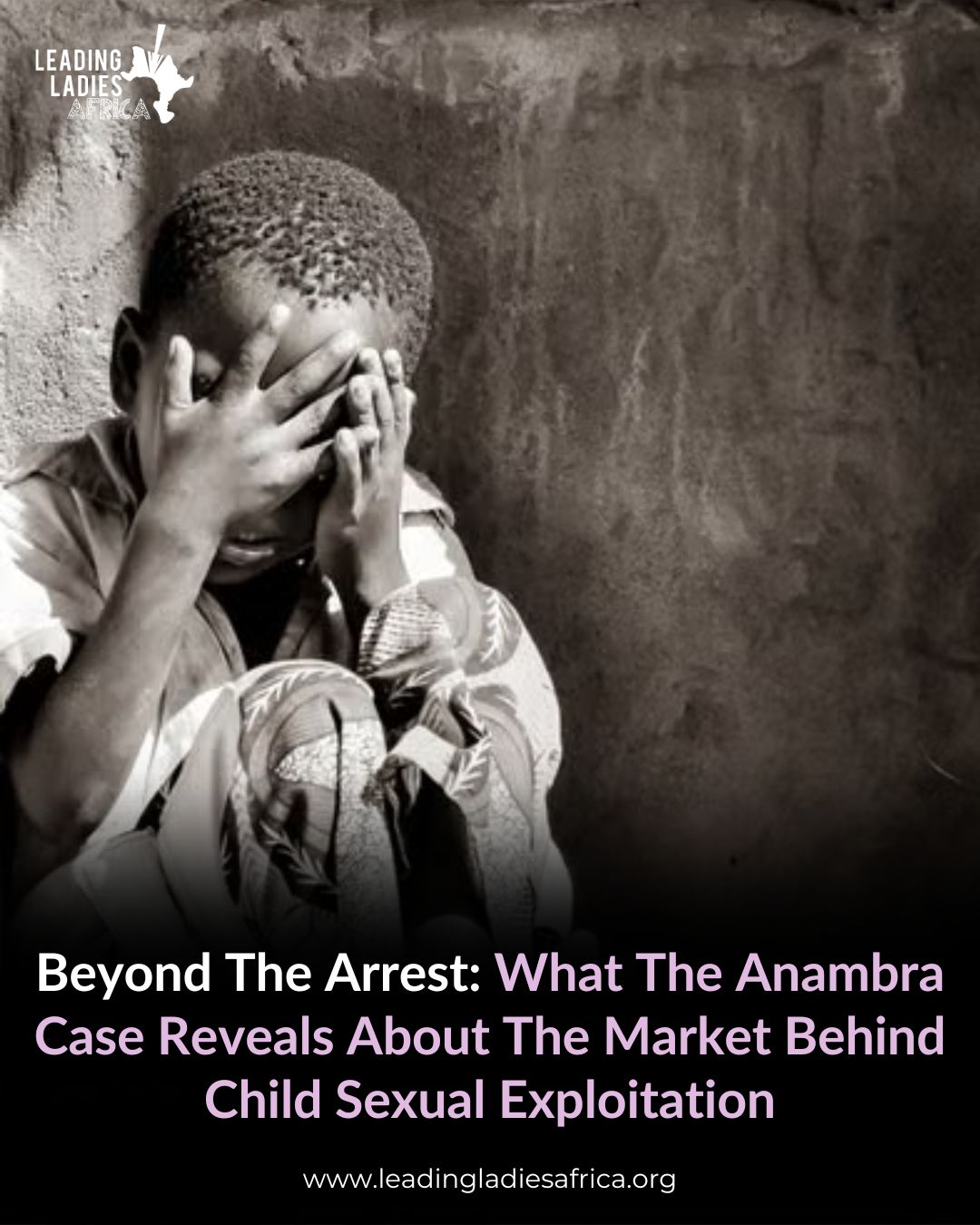
There is something deeply disturbing about the Anambra child abuse case that should stay with us long after the headlines move on.
A child was allegedly sexually abused. The abuse was reportedly recorded and uploaded online. And according to reports from the ongoing police investigation, the material was allegedly being used to make money, with the suspect reportedly telling investigators that she had received as much as $300.
That detail changes the conversation, because if someone could allegedly make money from the sexual exploitation of a child, then there was someone willing to pay for it, and that means we are no longer talking only about one woman and one horrific act. We are talking about an ecosystem: the person who allegedly committed the abuse, the people who paid to see it, the people who consumed or distributed it, the platforms that carried it, the systems that processed the transactions, and the institutions responsible for protecting children and bringing perpetrators to justice.
That is what makes this case so difficult to look away from.
A Child Is Not A Product
The police investigation is still ongoing, and allegations must be established through due process. But the reported details are horrifying enough to demand serious questions about how children are being treated in a digital economy that can turn almost anything into content.
A child is not content. A child is not a source of income. A child is not a commodity that an adult can sell because they have access to her, and being a parent does not change that.
If the allegations in this case are established, an adult who was responsible for protecting a child instead allegedly used that child’s vulnerability to create material for financial gain. That is not simply a failure of parenting. It is an abuse of power and trust on the most fundamental level.
Parenthood is responsibility. It is not ownership.
Who Was Buying It?
This is the part of the conversation we cannot afford to soften. We often focus on the person who physically commits an act of abuse and stop there, but sexual exploitation exists because there is demand for it. Someone creates the material. Someone looks for it. Someone pays for it. Someone watches it. Someone shares it.
Those people cannot disappear behind a screen.
If an adult knowingly pays to watch a child being sexually abused, that person is not merely an observer. They are participating in a market built on the exploitation of children, and we need to be honest about what that means.
The person paying for the material is helping create the incentive to produce more of it. The person sharing it helps extend the harm. The person searching for it creates demand. The person who deliberately keeps it, circulates it or profits from it helps ensure that a child’s abuse does not end when the physical act ends.
The abuse continues every time the material is viewed, shared or sold.
That is why any serious investigation into this case cannot stop at the person arrested. If there is evidence of buyers, distributors or others involved in the production and circulation of the material, they must be identified and investigated too.
How Did This Become Possible Online?
There is another group that cannot be left out of this conversation: technology companies and digital platforms.
We do not yet know publicly which specific platform was allegedly involved in the reported transactions, and it would be irresponsible to speculate, but the broader issue is undeniable.
Digital platforms have built incredibly sophisticated systems for recommending content, identifying prohibited activity, processing payments, detecting fraud and keeping users engaged. They know how to find patterns. They know how to flag activity. They know how to remove content when their systems identify violations.
So when child sexual abuse material makes its way onto a platform, finds an audience and is allegedly monetised, “we didn’t know” cannot be the end of the conversation.
How was it uploaded?
How did it remain accessible?
How was it discovered by people looking for it?
How was money allegedly exchanged?
What safeguards were supposed to prevent it?
And once the material was identified, what happened to the accounts, payments and digital evidence connected to it?
These are not questions about blaming technology for abuse. They are questions about responsibility.
A company cannot celebrate the power of its technology when that technology helps it grow and then become powerless when the same infrastructure is used to harm a child.
“We removed it” is not enough.
Children should not have to be abused first and protected later.
This Is Bigger Than One Case
The uncomfortable reality is that the Anambra case may be one visible example of a much larger problem.
A recent UNICEF report estimated that about 20 million children aged 12 to 17 across 21 countries experienced at least one form of technology-facilitated sexual exploitation or abuse in a single year. Nearly 60 percent of the reported experiences occurred on mainstream social media platforms, including Facebook, Instagram, Snapchat, TikTok and WhatsApp. UNICEF also found that less than one percent of these experiences were reported to authorities.
Those figures are not Nigeria-specific, and they should not be used to suggest that every case looks like the one in Anambra, but they should destroy any idea that technology-facilitated child sexual exploitation is some rare internet horror story. It is not.
Technology has made it easier to record abuse, distribute it, find an audience, communicate with perpetrators and, in some cases, turn exploitation into money.
The internet did not invent child sexual abuse, but it has created new ways for that abuse to travel, and when one child’s abuse can potentially become a product that strangers buy and consume, we have to ask how many other children may be caught in markets we cannot see.
Nigeria Already Has Laws
Nigeria is not without laws protecting children. The Child Rights Act criminalises the sexual abuse and sexual exploitation of children, including exploitation connected to pornography. There are also cybercrime laws that address certain forms of illegal sexually explicit material involving children.
So the answer cannot simply be that Nigeria needs another law. Laws matter, but laws sitting on paper do not protect a child. Enforcement does. Investigation does. Digital-forensics capacity does. Cross-border cooperation does. Specialised investigators do. Prosecution does, and properly funded child-protection systems do.
If the people buying and distributing child sexual abuse material are difficult to trace, then we need investigators equipped to follow digital trails. If money is changing hands, investigators need to follow the money. If material is being hosted or circulated on platforms, those platforms need to cooperate with lawful investigations and preserve relevant evidence.
An arrest is not the finish line. It is the beginning of the investigation.
What Happens To The Children?
Four children were reportedly rescued in connection with the Anambra operation. That is important, but rescue is not recovery. The children need safety. They need privacy. They need appropriate medical and psychological care. They need trauma-informed support and stable environments in which they can begin to recover. They need protection from further exploitation and from becoming permanent public symbols of the worst thing that happened to them, and they need that support long after the public has moved on to the next story.
Too often, our response to cases of violence against children ends at exposure and arrest. We are outraged. We demand justice. The police announce an arrest. The story trends. Then we move on, but a child does not move on simply because the internet has found something else to talk about. The work of protecting that child continues.
Stop Making Child Safety A Parenting Problem Alone
There is also a tendency to respond to online child exploitation by telling parents to monitor their children more closely. Parents and caregivers absolutely have responsibilities, but children cannot be expected to protect themselves from adults who have deliberately decided to exploit them. Telling parents to “monitor their children online” does not address the adults who seek out child sexual abuse material. It does not dismantle the markets where that material is exchanged. It does not make platforms safer. It does not strengthen digital investigations. It does not prosecute buyers.
The responsibility has to be much wider. Government has a responsibility. Law enforcement has a responsibility. Technology companies have a responsibility. Platforms have a responsibility. Communities have a responsibility, and every adult who encounters this kind of abuse has a responsibility not to make it worse.
We Also Need To Stop Making Abuse Into Gist
If you encounter child sexual abuse material, do not download it. Do not save it. Do not forward it to your friends. Do not ask someone to send it to you because you “want to see what happened.” Do not repost it for engagement. Do not turn a child’s abuse into WhatsApp gist.
A child being sexually abused is not content. It is not entertainment. It is not something for public consumption. It is evidence of a crime. Report it through the appropriate channels and allow trained authorities to handle the evidence. Every unnecessary share creates another copy of a child’s trauma.
Everyone Who Had A Hand In The System Needs To Answer
The Anambra case should not become another story where one person is arrested and everyone else disappears from the conversation. If the allegations are established, the person responsible for the abuse must face the law, but if other people knowingly paid for, consumed, distributed or profited from the material, they must be investigated too.
If digital platforms allowed child sexual abuse material to be uploaded, circulated or monetised because their safeguards failed, those failures need to be confronted. If payment systems were used to facilitate exploitation, those trails need to be followed. If law enforcement lacks the capacity to trace the people behind the screens, that capacity needs to be built, and if children are rescued without receiving the long-term support they need, then our definition of “protection” is incomplete.
There is a tendency to talk about child protection as though it is simply about keeping children away from danger. It is also about holding adults and institutions accountable when they create, enable or ignore that danger.
We Need More Than Outrage
The Anambra case is horrifying, but outrage alone will not protect another child. What will protect children is a system that takes their safety seriously before a disturbing video becomes viral. It is investigators who have the resources and expertise to follow the entire chain of exploitation. It is platforms that build child safety into their systems instead of treating it as an afterthought. It is laws that are actually enforced. It is communities that report abuse instead of circulating it. And it is adults who understand that a child’s vulnerability is never an invitation to exploit them.
Most importantly, it is a society willing to say clearly that children are not products, their pain is not entertainment, and their bodies are not commodities.
If there is a market for the sexual exploitation of children, then we need to find that market and dismantle it.
We need to find the people buying.
We need to find the people selling.
We need to find the people distributing.
We need to examine the platforms carrying it.
We need to strengthen the institutions responsible for stopping it.
And we need to protect the children left behind when everyone else has stopped talking.
There is enough outrage. Government must act. Law enforcement must act. Technology companies must act. Platforms must act. And every adult with the power to protect a child must use it.