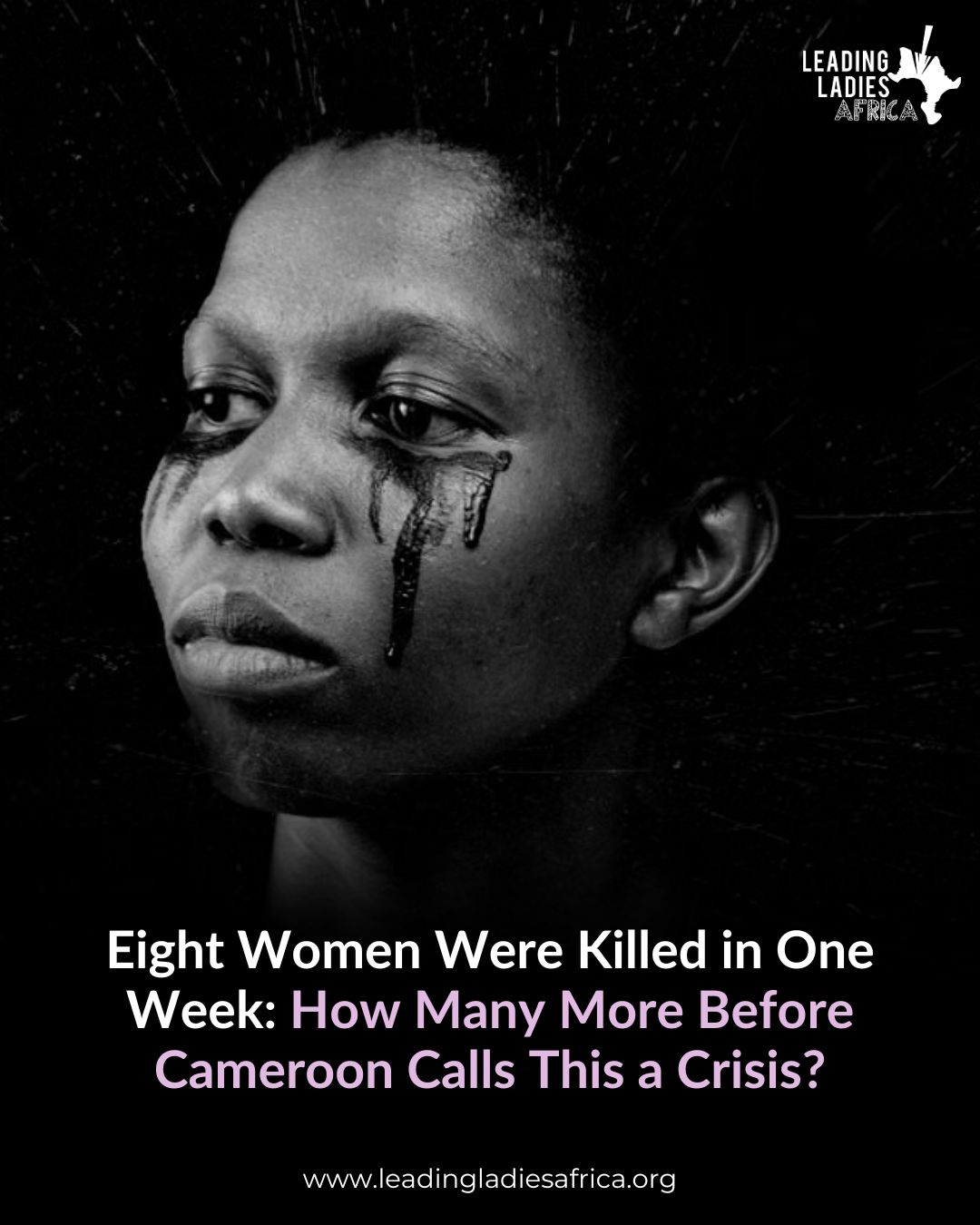
Between August 6 and August 26, 2026, 14 women were reportedly killed across Cameroon. Eight of those women were killed in a single week. Think about that for a moment.
In just seven days, eight women lost their lives. Some were reportedly killed by husbands, boyfriends or former partners. Some died inside homes where they should have been safe. Others were allegedly attacked after trying to leave abusive relationships. A woman was killed every 34 hours during that period, and somehow, we are still expected to treat this as a private matter.
They Were Not Statistics. They Were Women.
Take Diane Yidi Ebabi. Diane was reportedly strangled by her boyfriend in Efoulan, Yaoundé. Her body was allegedly hidden in his room for two days before she was buried, and he reportedly confessed to the killing nine days after she disappeared. She was 19 years old. She should have been thinking about her future, not becoming a name we have to mourn.
Then there was Modestine, a 34-year-old mother of two. Her husband allegedly barricaded the doors of their home in Douala so she could not escape before killing her with a butcher’s knife. Her two young children reportedly watched their mother die. There is no way to make that sentence less horrifying.
In Mbalmayo, Delphine Bih was reportedly poisoned by her husband, Kpwe Julius, who allegedly laced her roasted pork with rat poison. She became violently ill and died in the home she shared with him. Imagine sitting down to eat beside the person you love, never knowing that he has allegedly decided you will not live through the meal.
Daïna Tikeng had reportedly escaped an abusive relationship when her husband allegedly tracked her down and killed her. She did what we so often tell women to do when a relationship becomes dangerous: she left, but what does “just leave” mean when there is nowhere safe to go and no system waiting to protect you?
Beguel Merline was a teacher in Yaoundé. She reportedly met a man online and agreed to meet him at Hotel Le Salvador. She went to that meeting and never came home.
Noumbop Laure was reportedly stabbed four times. Kenfack Fortune was allegedly thrown from a moving vehicle. A mother of three was reportedly decapitated and found under a bed in Tsinga. A 44-year-old woman was reportedly stabbed in a hotel room, while a 16-year-old girl was reportedly raped and murdered. Fourteen women. Twenty days. Every one of them was a person before she became a headline.
This Did Not Start in August
The horror of these cases is not only in the number of women killed in August. It is in the fact that the numbers have been rising for years. In 2023, 50 women were reportedly killed in Cameroon. In 2024, that number rose to 67. In 2025, it rose again to 77. By April 2026, another 50 women had reportedly been killed. Fifty women in just four months.
How many more times must the numbers rise before we stop calling this a tragedy and start calling it a crisis?
When “Domestic” Becomes an Excuse
Many women are reportedly killed by men they know: husbands, boyfriends, partners and former partners. That matters because these are not random acts of violence. In many cases, the perpetrators know where these women live, where they work, what their routines are and how to reach them. Some women are reportedly killed after trying to leave. Others are killed inside their own homes, and yet violence against women is still too often reduced to a “domestic dispute”, as though the word domestic makes a woman’s death less serious.
It does not. A woman being killed by her partner is not simply a private disagreement that went too far. It is violence, and it requires a response that matches the seriousness of the threat.
Cameroon Has a Legal Gap
Cameroon currently does not have a specific criminal offence for femicide, meaning gender-based killings of women are prosecuted under broader homicide laws. Activists and human rights organisations have called for stronger legal protections and greater recognition of the specific nature of violence against women, because language matters.
If a woman can be killed because she is a woman, the law should be able to recognise that reality. Women should not have to die before the systems meant to protect them are forced to acknowledge what is happening.
Cameroon Called It a National Emergency. So What Happens Next?
In August, seven government institutions held a joint press conference declaring violence against women a national emergency. That matters, but declarations are not protection. Condemnations do not stop perpetrators. Statements do not give survivors somewhere safe to sleep. Press conferences do not prosecute abusers.
If this is a national emergency, where is the urgency? Where are the stronger laws? Where are the shelters? Where is the protection for women trying to leave violent relationships? Where is the accountability for perpetrators? Cameroonian footballer Ajara Nchout Njoya captured the heart of the issue when she spoke against the violence and said that being a woman in Cameroon should never be a risk. She is right. Women should not have to die before their country decides their lives are worth protecting.
This Is Bigger Than Cameroon
Cameroon is not alone in confronting violence against women. Across Africa, women continue to face intimate partner violence, rape, sexual violence and femicide, while survivors are too often pressured into silence and families are left to pick up the pieces. The names change. The countries change. The excuses barely do. That is why this cannot simply be another list of women killed in one month.
It is a question about the systems around them. What happens when a woman reports abuse and is not believed? What happens when she leaves and has nowhere safe to go? What happens when laws do not adequately recognise the violence she is facing? What happens when perpetrators believe they can act without consequences? We already know the answer to what happens when those systems fail. Women die.
Protection Has to Come Before the Funeral
Women need laws that protect them, police that take their reports seriously, courts that prosecute perpetrators and shelters that give survivors somewhere safe to go. Cameroon needs stronger legal recognition of femicide and institutions that treat violence against women with the urgency of the emergency it has already declared, because protection has to come before the funeral, not after it.
Diane. Modestine. Delphine. Daïna. Beguel. Noumbop. Kenfack. And every woman whose name may never make it into a headline deserved to live.
Their deaths cannot become another list we read, mourn and eventually forget.
We are seeking justice for the women we lost, protection for the women still here, and a Cameroon where being a woman is never a risk to your life.