There is a particular kind of dissonance that feminist organisations have lived with for a long time and not always named directly. We build movements around the redistribution of power. We write strategies about dismantling hierarchy. We publish reports on the underrepresentation of women in leadership and the structural barriers that keep them out and then we go back to our offices or our Zoom calls, or our field operations and we report to a single executive at the top, making decisions alone, burning out quietly, replicating in our own structures the exact dynamics we have spent decades challenging in everyone else’s.
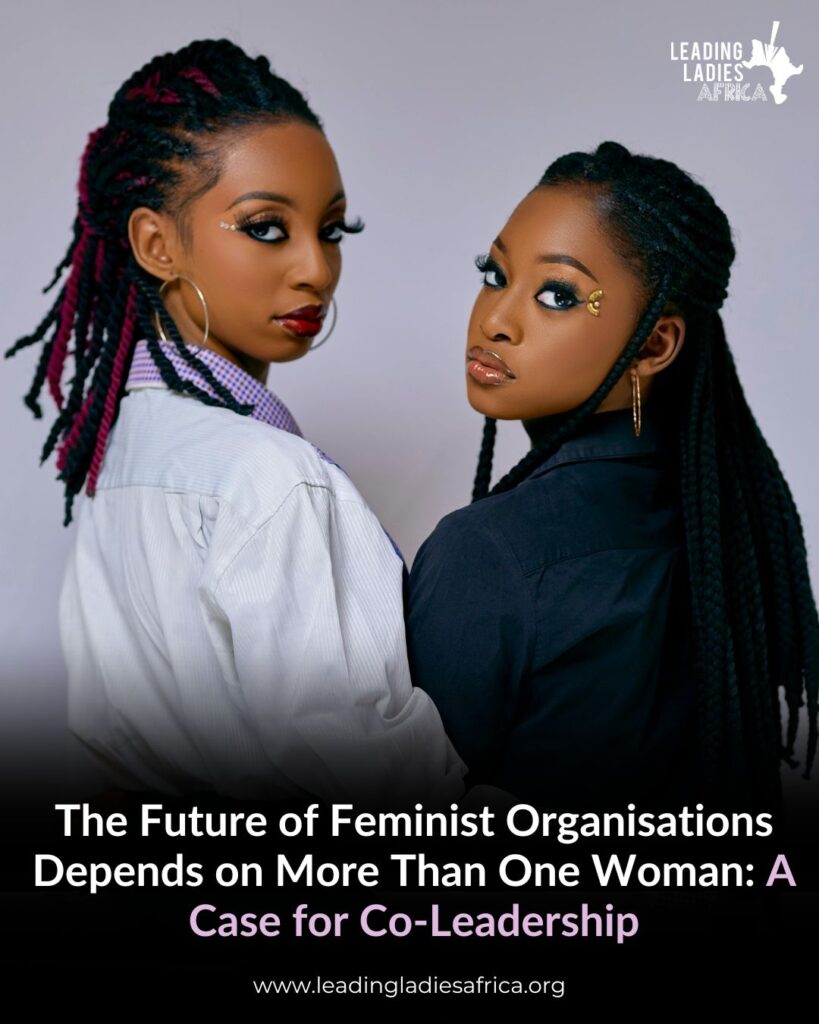
Feminist co-leadership is the honest answer to that contradiction. Not a compromise, not a structural workaround, not a concession to the difficulty of finding one perfect leader. A deliberate, values-driven choice to build organisations that lead the way they want the world to lead, with power shared, authority distributed, and no single person carrying everything alone.
What Co-Leadership Actually Is
Co-leadership, in its feminist framing, is more than two people sharing a job title. It is a structural commitment to the principle that power is better held collectively than concentrated, that two leaders with different backgrounds, experiences, and ways of seeing will make better decisions together than either would make alone, and that the organisation benefits from that difference rather than being slowed down by it.
Feminist co-leadership builds power with rather than power over. It makes power dynamics transparent rather than obscuring them behind a single authoritative figure. It forces ongoing dialogue, mutual accountability, and the kind of productive tension that single-leader models tend to eliminate in favour of efficiency and it distributes the emotional, strategic, and operational weight of leading in ways that make sustainable leadership possible, particularly for women working in sectors that are underfunded, emotionally demanding, and personal in ways that most leadership literature does not adequately account for.
This is not a theoretical model. It is a working one, being practised right now by some of the most respected feminist organisations on the continent and globally.
The Organisations Already Doing This
Womankind Worldwide, a pan-African and global feminist organisation working at the intersection of women’s rights, gender equity, and transformative leadership is led by two Co-CEOs. Disha Sughand is based in the UK. Diana Njuguna is based in Kenya. Their co-leadership is not incidental to Womankind’s work, it is an expression of it. Diana has spoken about her aspiration to drive conversations around feminist trust-based philanthropy, the power of lived experience from an intersectional lens, and dismantling the power dynamics that prevent community-based organisations from taking their rightful place in movements. Disha has spoken about leading with humility, working collaboratively, and ensuring the organisation lives its values by being more partner-centred. Together, they are not just running an organisation. They are modelling what they advocate for.
FRIDA, The Young Feminist Fund, which resources young feminist organising globally, operates under Co-Executive Directors Paige and Nada, both of whom were promoted from within the organisation they now lead.
FAIR SHARE of Women Leaders, an organisation that literally measures how well the development sector invests in women-led organisations, practices co-leadership internally, because an organisation whose entire mission is the redistribution of power in civil society understood that it needed to demonstrate that redistribution in its own structure.
Girls Not Brides, the global partnership working to end child marriage, operates with shared executive leadership across its work.
FEMINIST, an intersectional media platform, is co-founded and co-led by Ky Polanco and Aisha Becker-Burrowes.
These are not experiments. They are not provisional arrangements while the organisation figures out who the real leader is. They are deliberate, sustained, values-driven structural choices made by organisations that understand something important, that how you lead is inseparable from what you stand for.
The Problem With the Lone Leader Model
The traditional single-CEO structure was not designed with women in mind. It was built for a world in which the person at the top of an organisation had, behind them, a domestic infrastructure, usually a wife, managing everything else. The children, the household, the social obligations, the emotional labour, the invisible work that makes professional availability possible. It assumed a kind of uninterrupted, undivided capacity that most women, and especially women of colour, have never had equal access to.
It also concentrates risk. A single leader carries a single vision, a single set of blind spots, and a single breaking point. When that leader burns out, and in feminist civil society, where the work is emotionally demanding, underfunded, and deeply personal, burnout is not exceptional but endemic, the organisation pays the price. When that leader leaves, the institutional knowledge, the relationships, and the strategic memory often leave with them.
Co-leadership distributes all of this. It means no single person carries the full weight. It means rest is not a failure of commitment but a structural feature of how the organisation sustains itself. It means decisions are made through dialogue rather than decree, and that the organisation’s survival does not depend on any one person’s ability to keep going indefinitely. For feminist organisations working on issues that are both professionally demanding and personally resonant, this is not a luxury. It is a survival strategy.
It Produces Better Decisions
Beyond sustainability, co-leadership produces better outcomes. Two leaders with genuinely different backgrounds, networks, and perspectives will catch what one leader alone would miss. They will ask different questions of the same problem. They will bring different relationships to the same table. They will challenge each other’s assumptions in ways that a single leader, however thoughtful, cannot replicate through internal reflection alone.
Co-leadership structurally prevents the echo chambers that form around powerful individual figures, the dynamic where the leader’s perspective gradually becomes the organisation’s perspective, unchallenged and unexamined. It forces the kind of ongoing negotiation and dialogue that is harder than having one person decide, and more rigorous than any governance structure that concentrates final authority in a single point.
This is not idealism. It is what Womankind’s co-CEOs describe when they talk about harnessing complementary skills and making decisions informed by diverse viewpoints. It is what FRIDA’s co-leadership demonstrates when two leaders who came up through different parts of the same organisation bring different institutional knowledge to every strategic decision. The organisations doing this have not found it easy. They have found it better.
Co-Leadership Only Works If It Is Genuine
Sharing a title is not co-leadership. A structure where one person is clearly the real decision-maker and the other is present for optics is not feminist co-leadership, it is tokenism with a different label. Genuine feminist co-leadership requires mutual respect between leaders who see each other as equals, honest and sometimes difficult communication, shared accountability for outcomes, and the institutional commitment to support the model rather than quietly undermining it by always looking for the single person in charge.
It requires organisations to actively unlearn the instinct, embedded in most of our professional cultures, to identify the real leader and redirect all significant power accordingly. It requires funders and boards and staff to resist the pull toward the clarity of a single authoritative figure and trust instead the more complex, more rigorous clarity that shared leadership produces. That unlearning is not automatic. It is, itself, a form of the feminist work.
A Message to Donors and Funders
Feminist co-leadership models still encounter scepticism in funding conversations. Questions about who the real decision-maker is. Requests for a single point of contact. Assumptions that shared leadership means unclear leadership or diffuse accountability. This scepticism is worth naming directly for what it is, a funder’s institutional bias showing up as a structural barrier to the governance choices of the organisations they fund.
If you fund feminist organisations, you are or should be funding their values as well as their programmes. When a feminist organisation chooses co-leadership as an expression of its commitment to shared power, scrutinising that choice in funding conversations is scrutinising feminism itself. Supporting feminist co-leadership means actively adapting your funding processes to accommodate it, accepting communications from multiple leaders, evaluating governance structures on their alignment with organisational values rather than on their resemblance to corporate norms, and recognising that the organisations doing this work well are doing it precisely because they have chosen structures that reflect what they believe.
The Question Is Not Whether It Works
The organisations practising feminist co-leadership are proving, consistently, that it works. They are demonstrating that shared power produces sustainable, rigorous, values-aligned leadership. They are showing that two leaders can hold an organisation together more sustainably than one, make better decisions than one, and model more honestly than one the kind of world their work is trying to build.
The question for every feminist organisation still operating with a lone leader at the top is not whether co-leadership is possible. It is whether the organisation is ready to mean what it says about power. Whether it is willing to do the harder, slower, more honest work of building structures that reflect its values all the way to the top. Whether it understands that the internal has to match the external, that you cannot campaign for the redistribution of power in the world and concentrate it in a single person at the top of your own organisation without the contradiction eventually becoming the loudest thing about you.
Share the power. Model the world you are building. Lead the way you want others to lead. The organisations already doing this are not waiting for permission. They are showing the rest of us what is possible.