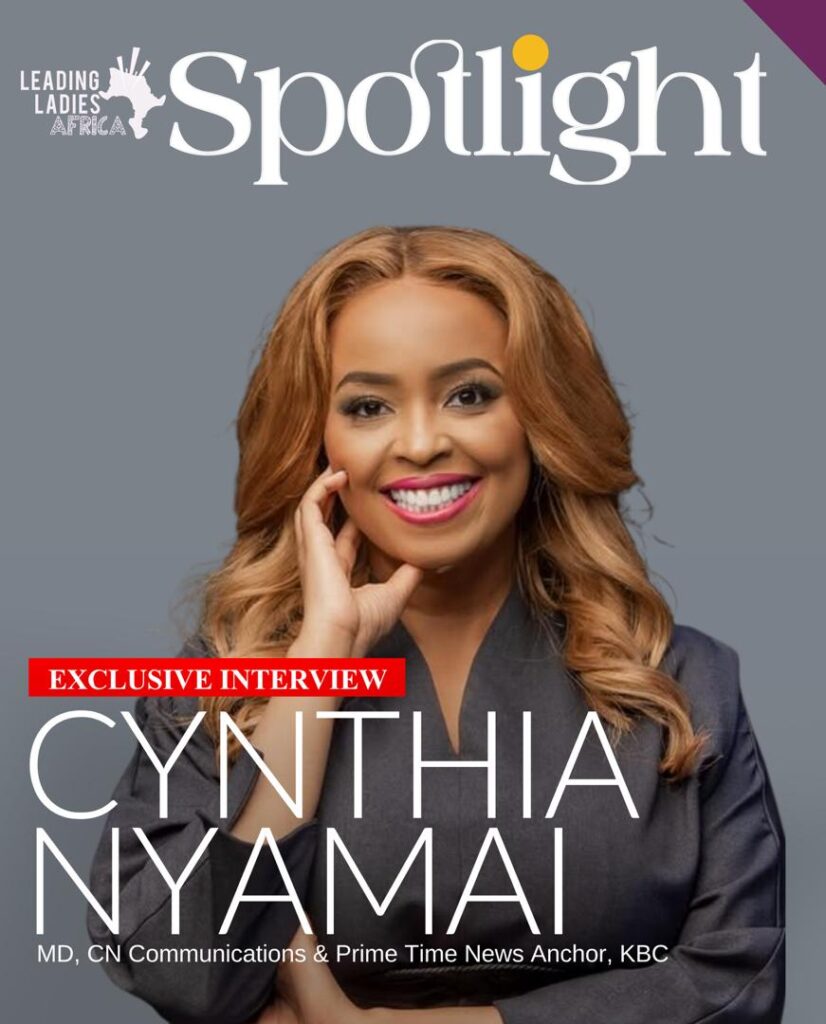
For more than two decades, Cynthia Nyamai has built a career at the intersection of media, leadership, communications, and influence. Widely recognized as one of Kenya’s most respected journalists and strategic communications experts, she has spent years shaping public conversations, advising leaders and institutions, and helping tell the stories that define Africa’s present and future.
Her journey began in the newsroom, where she rose to prominence as a business journalist and became the first Kenyan to win the Best Upcoming Business Journalist in Africa award at the prestigious Diageo Business Journalism Awards. Since then, she has evolved into a leading communications strategist, entrepreneur, and thought leader, building a reputation for excellence, credibility, and impact across multiple industries.
Today, Cynthia serves as the Managing Director of CN Communications, where she advises organizations, governments, and leaders on strategic communications, reputation management, and public engagement. She is also the Head of Issachar Alliance East Africa, a leadership platform focused on shaping values-driven leaders, while continuing her work in broadcast journalism as a prime-time news anchor at KBC Channel 1.
Throughout her career, Cynthia has remained passionate about leadership, governance, business, and Africa’s development story. Whether behind a news desk, in a boardroom, or on a public platform, her work has consistently centered on helping people and institutions communicate with clarity, purpose, and integrity.
In this edition of LLA Spotlight, Cynthia reflects on her journey from journalism to entrepreneurship, the realities of navigating male-dominated spaces, the future of women in African media, and why influence means far more than visibility. She also shares her thoughts on leadership, legacy, and the responsibility of creating pathways for the next generation of African women to thrive.

Cynthia, you have spent your career telling other people’s stories. Today we want to hear yours, who is Cynthia Nyamai and what has this journey been about?
My journey has been about purpose, influence, and building systems that outlive me.
I began as a journalist with a deep curiosity about people, power, business, and Africa’s future. Journalism taught me how to listen beyond headlines and how to understand the human story behind institutions, leaders, and nations.
Over the years, my path evolved from reporting stories to shaping conversations, advising leaders, and helping organizations communicate with clarity and impact. Today, I work at the intersection of media, diplomacy, leadership, and strategic communications across Africa.
But beyond the titles, I believe my life’s assignment is to help shape thought, build bridges, and raise a generation that leads intentionally. Everything I do, whether in media, PR, leadership development, or writing, comes back to that.
You built a remarkable career at KTN before moving to KBC. What did those early years teach you about the kind of journalist you wanted to become?
Those years taught me the power of preparation, discipline, and credibility.
Newsrooms are intense spaces. You learn quickly that talent alone is not enough. You must be informed, resilient, and consistently excellent.
At KTN and later KBC, I learned that journalism is not simply about being on television. It is about responsibility. The stories we tell shape perception, policy, and public trust.
I also realized early that I was drawn to stories about business, leadership, governance, and transformation because those stories determine the direction of nations. I did not want to simply report events. I wanted to understand systems and the forces shaping Africa’s future.
You became the first Kenyan to win Best Upcoming Business Journalist in Africa at the Diageo Business Awards. What did that moment feel like and what did it say to every young African woman watching from the sidelines?
It was deeply humbling. At the time, I do not think I fully understood the significance of the moment. I was simply committed to doing excellent work.
But looking back, I realize it represented possibility. It said that an African woman could enter rooms traditionally dominated by men, ask intelligent questions, understand complex economic issues, and compete at a continental level.
I hope it reminded young women that they do not need permission to pursue greatness. Your background does not have to limit your future. Excellence speaks. Preparation speaks. Consistency speaks.
And sometimes the room may not immediately recognize your value, but that does not mean your value is absent.
Media can be an unforgiving space for women, particularly women who refuse to be small. What have you had to fight for in a room that did not always make space for you?
As a business journalist, I would sometimes interview powerful business leaders who, after a conversation, would remark:
“For a beautiful woman, you are very intelligent.”
And while some may have intended it as a compliment, it revealed something deeper about how women , especially women in media , are often perceived. There is still an assumption in some spaces that a woman can either be taken seriously intellectually or admired physically, but rarely both.
So I had to fight against being underestimated. I had to ensure my preparation was undeniable, my work was excellent, and my understanding of business, economics, and leadership was deep enough that eventually the conversation shifted from how I looked to the value I brought into the room.
I also had to learn not to shrink myself. Not to soften my voice, my ambition, or my intelligence to make others comfortable.
Over time, I realized something important: the goal is not simply to enter rooms that did not make space for you. The goal is to build influence strong enough that you help redesign the room itself for the women coming after you.

Walking away from a thriving media career to build your own consultancy is a bold move. What were you willing to risk and what were you no longer willing to settle for?
I was willing to risk comfort for purpose.
Employment offers structure and predictability, but entrepreneurship requires vision, courage, and uncertainty.
At some point, I realized I wanted to build something larger than myself , something that could influence governments, businesses, leaders, and conversations across Africa.
I was no longer willing to settle for limitation, dependency, or shrinking my ideas to fit existing systems. I wanted ownership. I wanted freedom to build. I wanted impact beyond a newsroom desk.
The transition was not easy. Entrepreneurship humbles you. But it also reveals your capacity.
Journalism and PR sit on opposite sides of the same story. How has moving between both worlds shaped the way you communicate, lead, and build?
It gave me balance.
Journalism taught me how to ask difficult questions, seek truth, and understand public accountability. PR taught me strategy, positioning, relationship management, and long-term narrative building.
Because I understand both worlds, I communicate differently. I know how media thinks, how audiences respond, and how leaders must prepare before entering public spaces.
It also taught me that communication is not simply about visibility. It is about trust. The strongest brands, leaders, and institutions are not the loudest. They are the most credible and consistent.
What is the story African media is still not telling loudly enough and who is being left out because of that silence?
Africa’s story of builders is still under-told.
There are extraordinary Africans building systems, companies, technologies, policies, institutions, and movements that are shaping the future quietly.
Too often, African media focuses heavily on crisis, politics, or conflict while underreporting innovation, governance reform, entrepreneurship, diplomacy, and long-term vision.
We also do not tell enough stories about African women beyond survival narratives. Women are not only surviving. They are building economies, shaping policy, leading industries, and transforming communities.
The danger of silence is that generations grow up without models of possibility. Representation matters because stories shape imagination.
What needs to change for women in African media to move from being in front of the camera to owning what happens behind it?
Women must move from visibility to ownership.
Ownership of media houses. Ownership of production companies. Ownership of strategy rooms. Ownership of capital and decision-making spaces.
We need more women becoming editors, producers, investors, founders, and policymakers , not just presenters.
But this also requires mentorship, access, financial literacy, and systems that intentionally prepare women for leadership.
Most importantly, women must stop underestimating themselves. Many women are highly capable but conditioned to play supporting roles. Africa needs women who are willing to lead boldly, build institutions, and shape culture intentionally.

What do you want young Kenyan women dreaming of a career in media or communications to know before they start, the truth nobody tells them?
I want them to know that the industry can look glamorous from the outside but true success is built quietly.
Your reputation will become your currency. Protect it.
Your discipline will matter more than hype.
Your preparation will open more doors than connections alone.
I also want them to understand that visibility is not the same as influence. Do not chase fame at the expense of substance. Build competence. Read widely. Understand business, governance, technology, diplomacy, and culture.
And finally: do not build only a career. Build capacity. Build character. Build emotional resilience. Because the higher you rise, the more important your inner life becomes.
When all is said and done, what do you want the name Cynthia Nyamai to stand for?
I want it to stand for integrity, courage, transformation, and intentional leadership.
I want people to say that I helped build conversations that mattered, opened doors for others, and used influence responsibly.
I want my life to represent the possibility of an African woman who refused limitation, built across industries, and remained committed to purpose.
More than success, I want legacy.
Not just visibility, but impact.
Not just achievement, but transformation.