Africa is often celebrated for its booming workforce but numbers alone have never built anything. Marcia reminds us that without leadership systems strong enough to channel all that human potential, a demographic dividend is just a demographic. The real question isn’t how many people we have. It’s who is leading them, and whether those leaders have the structures, accountability, and vision to convert raw potential into sustained economic output.
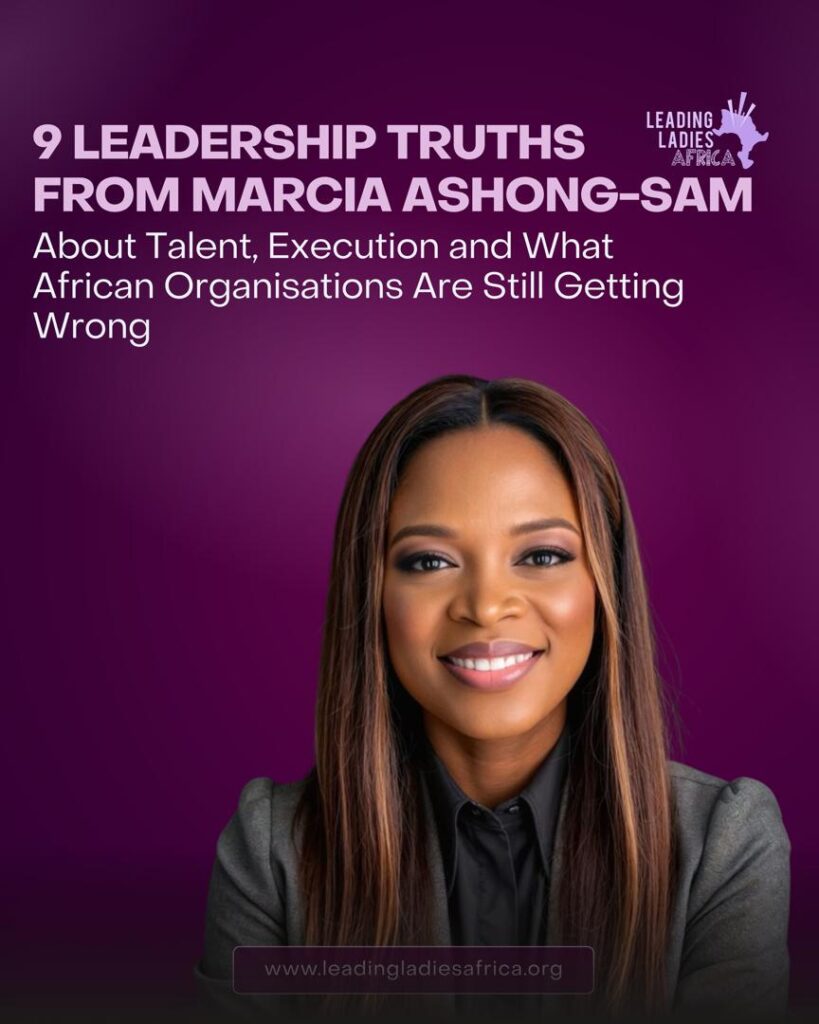
Marcia Ashong-Sam, Founder and CEO of TheBoardroom Africa, has built her career at the intersection of leadership and opportunity and what she’s seen across boardrooms, markets, and executive searches across the continent? Most organisations are getting leadership completely wrong.
Swipe through for 9 hard truths about African leadership that every professional, founder, and organisation needs to hear.

Population Is Not Power
Africa is often celebrated for its booming workforce but numbers alone have never built anything. Marcia reminds us that without leadership systems strong enough to channel all that human potential, a demographic dividend is just a demographic. The real question isn’t how many people we have. It’s who is leading them, and whether those leaders have the structures, accountability, and vision to convert raw potential into sustained economic output.
The Problem Was Never a Shortage of Talent
Capital is available. Brilliant people are everywhere but too many organisations keep hiring from the same narrow pool, defaulting to familiar faces and conventional definitions of what a leader should look like. The precision with which leadership is matched to opportunity remains inconsistent across the continent, and that gap is costing organisations enormously. When you redefine what leadership success looks like in your specific context and search accordingly, everything changes.
Define Leadership Before You Go Looking For It
Most companies treat leadership as a hiring outcome, find someone impressive and put them in the seat. Marcia’s approach starts much earlier: what does leadership actually need to look like here, at this stage, in this organisation, in this market? That one shift in thinking, from hiring as an outcome to leadership as a strategic lever — unlocks more value than any single appointment ever could. The organisations that get this right start with definition, not with a job description.
Great Teams Beat Great Individuals Every Time
One brilliant person at the top cannot save a leadership team that doesn’t function as a unit. The organisations that scale are the ones built on collective effectiveness — clear accountability, disciplined execution, and leaders who make each other better. Individual capability is the floor, not the ceiling. What consistently separates high-performing organisations is not the quality of their best leader but the quality of how their leadership team functions together.
Strategy Is Not the Problem. Execution Is.
Most African organisations have a vision. They have a plan. They even have a roadmap. What breaks down is the ability to convert all of that into consistent, measurable outcomes, especially across the diverse, complex markets that define this continent. The gap between strategy and execution often reflects deeper issues: weak accountability structures, misaligned priorities, and leaders who are brilliant at articulating the vision but struggle to drive it into the operations. The leaders who can close that gap are the ones who will build what lasts.
Diversity as a Checkbox Changes Absolutely Nothing
When diversity is treated as a performance driver, embedded into how decisions are made and how different perspectives are actively integrated, the results are real and measurable. Stronger decisions. More resilient outcomes. Better performance. But a diverse org chart that still makes decisions the same old way is just decoration. Composition without inclusion is a press release, not a strategy. The organisations seeing real results are the ones that have connected diversity directly to how they operate, not those that treat it as a standalone goal to report on.
The Talent Is Ready. The Organisations Are Not.
There is a growing cohort of African leaders operating at the highest levels locally and globally shaped by international exposure, return migration, commercial acumen, and the kind of resilience that only comes from navigating complex, fast-evolving environments. The readiness is there. What lags behind is the ability of organisations to transform at scale, to move beyond awareness of change and actually redesign how they operate, how they create value, and how they deploy new capabilities. The talent has done the work. Now the institutions need to catch up.
Succession Is Not a Meeting. It Is a Culture.
Too many organisations treat succession planning as something to figure out when a leader is about to walk out the door. Marcia argues it has to be a living, continuous, forward-looking process — one that accounts not just for who fills a role, but for the transfer of influence, relationships, and informal power. That invisible currency — the control over strategy, capital, and organisational narrative that lives outside any job description — is what makes or breaks a leadership transition. Ignore it, and even the most carefully designed succession plan will fall apart in practice.
The Leaders Africa Needs Are Being Built Right Now
The pipeline is not broken beyond repair, but it demands deliberate investment, starting earlier than most organisations are comfortable with. The companies that will lead this continent in 2050 are the ones building leadership depth today. Identifying potential early. Creating stretch opportunities. Developing talent on purpose, not by accident. The future of African leadership is not a distant problem to be solved later. It is being shaped right now in every organisation that chooses to invest, and every one that chooses to wait.