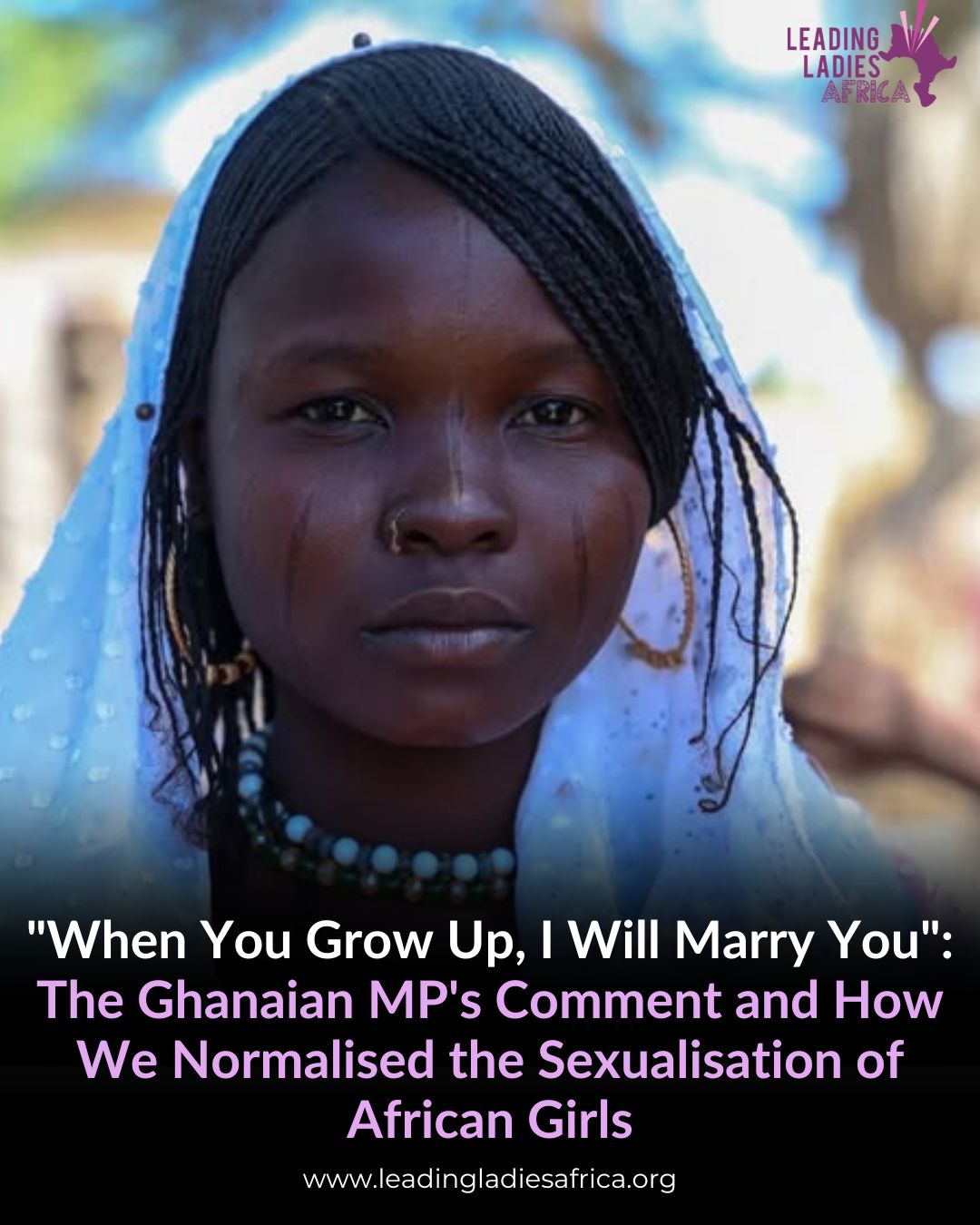
Hon. Yakubu Mohammed, 37-year-old Member of Parliament for Ahafo Ano South East, was addressing a group of primary school pupils visiting Parliament House in Ghana. These were children on a school excursion, young girls and boys brought to their country’s legislature to learn about governance, to see democracy in practice, to imagine what their futures might look like in rooms like that one. In the middle of his address, the MP stopped, singled out a nine-year-old girl, told her she was very beautiful, and said: “When you grow up, I will marry you, so she is my wife.”
He said it with ease. With a smile. With the unself-conscious comfort of a man who has never once been told that this is wrong. He did not hesitate. He did not lower his voice. He did not look around the room to check whether this was appropriate. He said it the way people say things they have always been allowed to say and then he moved on.
That ease is the whole story.
What He Did
There is a tendency, when incidents like this go viral, to let the outrage cycle do the work of naming the harm, to assume that because people are angry, the nature of what was done is understood. It is not always. So let us be precise.
A 37-year-old man in a position of institutional authority used a public platform, in his country’s parliament, during an educational visit by primary school children to assign a nine-year-old girl a matrimonial identity she did not choose and could not refuse. He called her his wife. In front of her classmates. In front of her teachers. On camera. Without hesitation, without embarrassment, without any apparent awareness that what he was doing required either.
He was not making a private remark. He was not speaking in a context where the child could not hear him. He was speaking directly to and about a child, in a room where his words had weight, using language that placed a romantic and possessive claim on her body and her future and framing it as a compliment.
That is what happened. Not a slip of the tongue. Not a moment of poor phrasing. A grown man, in parliament, telling a child she belongs to him.
The Apology That Came After the Outrage
When the video went viral and the public response was swift and furious, resignation calls, a formal petition to the Speaker of Parliament, civil organisations condemning the comment across social media, Hon. Yakubu Mohammed responded but not immediately with an apology. First, with a defence.
The comment, he explained, was rooted in a traditional joking relationship between the Mossi and Dagomba ethnic groups, a long-standing cultural custom of friendly, playful exchange between the two communities. It was not intended to cause harm or discomfort. It was cultural context. It was a joke.
Only after it became clear that this explanation was not going to satisfy anyone did the formal apology arrive, an official statement in which he acknowledged that irrespective of intention or traditional context, the comment was inappropriate because it involved a child. He expressed sincere regret. He promised to visit the girl’s family in person to offer amends. He reaffirmed his commitment to child welfare and dignity.
The statement was well-worded. It covered all the necessary bases. And it arrived precisely when the public pressure made it impossible to delay any further.
This is the part we need to sit with.
An apology that comes only after viral outrage, only after resignation demands, only after a formal parliamentary petition, that apology is not evidence of remorse. It is evidence of calculation. If Hon. Yakubu Mohammed genuinely understood, in his conscience, that what he said to that child was wrong, he would have caught himself before the words left his mouth. Or in the moment after. Or when he saw the video. He did not. He smiled and moved on, because in his world and in far too many rooms across this continent, what he said is not considered a problem until enough people make enough noise about it.
The apology did not come from conscience. It came from consequences. And those are not the same thing.
Why the Defence Told the Real Story
The most revealing moment in this entire sequence was not the original comment and not the eventual apology. It was the defence that came between them, the instinctive reach for cultural justification before the reach for remorse.
Before he said it was wrong, he said it was normal. Before he apologised, he explained and that explanation, that this is a tradition, a cultural joke, a harmless expression of ethnic kinship, is precisely the framework that has allowed this kind of language to persist, unchallenged and unexamined, across communities throughout the continent.
He was not lying about the cultural context. The Mossi-Dagomba joking relationship is real. And that is exactly the problem. The harm being done here is not exceptional or aberrant, it is embedded in cultural practices so familiar and so long-standing that the person engaging in them cannot initially even recognise that they constitute harm. That is not an excuse. It is a diagnosis.
The Pattern Behind the Incident
What happened in that parliament is not exceptional. Remove the institutional setting, remove the camera, remove the public figure and what you have is something that happens across Africa every single day, in spaces so ordinary and familiar that most people have genuinely stopped noticing it.
At family gatherings, a man points at a toddler girl and calls her his wife. At naming ceremonies, an elder singles out a little girl and tells her she will marry his son. At church, at community meetings, at school, grown men establish romantic and possessive framings around girl children with such frequency and such ease that it has become part of the background noise of African girlhood. It is said warmly. It gets laughs. It is received as affection.
And it is doing specific, documented work. When an adult man calls a little girl his wife, repeatedly, casually, as a feature of normal interaction, he is teaching her that her beauty is something adult men assess and claim. That adult men have a stake in her future. That their romantic interest in her, however future-oriented, is a compliment she should receive with gratitude rather than discomfort. He is teaching boys watching that this is how men talk about girls. And he is teaching everyone in the room, through their laughter and their silence, that this framing of girls as future wives is so benign and natural that it requires no examination.
None of this is neutral. Language shapes reality — including the reality of how girls understand themselves, their value, and what they are entitled to expect from adult men.
This Is Where Child Marriage Begins
Africa has the highest rates of child marriage in the world. Every year, millions of girls are married before their eighteenth birthday. Some are married at twelve, at ten, at nine, the exact age of the girl in that Ghanaian parliament.
Child marriage does not begin with a formal ceremony. It begins with a culture that treats girls as future wives from the moment they are old enough to be considered pretty. With the language that establishes adult male romantic interest in girls as normal, expected, even flattering. With the family gatherings and community events and school excursions where grown men claim little girls and rooms full of adults see nothing worth interrupting.
The MP’s comment and the child marriage statistics are not two separate conversations about two separate problems. They are the same conversation, at different points on the same continuum, shaped by the same cultural logic, sustained by the same silences, producing the same outcome: girls who grow up in a world where adult men feel entitled to them, and where the institutions that should protect them are busy defending tradition.
What Accountability Actually Requires
Hon. Yakubu Mohammed has apologised. He has promised remedial action. These things are noted. They are not sufficient — because the problem was never only him, and a personal apology, however thorough, does not address what actually needs to be addressed.
Real accountability looks like parliament establishing clear, enforceable standards for how lawmakers interact with children, standards that treat the sexualisation of minors, however culturally framed, as a child protection matter rather than a conduct issue to be managed with a press statement. It looks like the National Democratic Congress taking a public position on what it expects from its members in interactions with minors. It looks like institutions, political, religious, educational, community, having the conversations they have been avoiding about the language adults use around girl children and what that language produces.
And it looks like every person who has ever been in a room where a grown man called a little girl his wife and said nothing, deciding, the next time, to say something.
The Girl in That Room
She went on a school trip. She sat in her country’s parliament, probably excited, probably imagining her own future in rooms like that one. And a man with the power to make laws about her life stopped the room, pointed at her, and made her briefly, publicly, someone’s future wife.
She did not choose it. She could not refuse it. She had no mechanism for objecting and no power in that room to say, this is not what I came here for, this is not who I am, my future is not yours to claim.
She was nine years old. Her future belongs to her not to a cultural tradition, not to a lawmaker’s sense of humour, not to any man’s assessment of her beauty or his claim on her when she grows up. Entirely, unconditionally, to her.
We are not accepting the apology as the end of this conversation. We are using it as the beginning of a louder one.