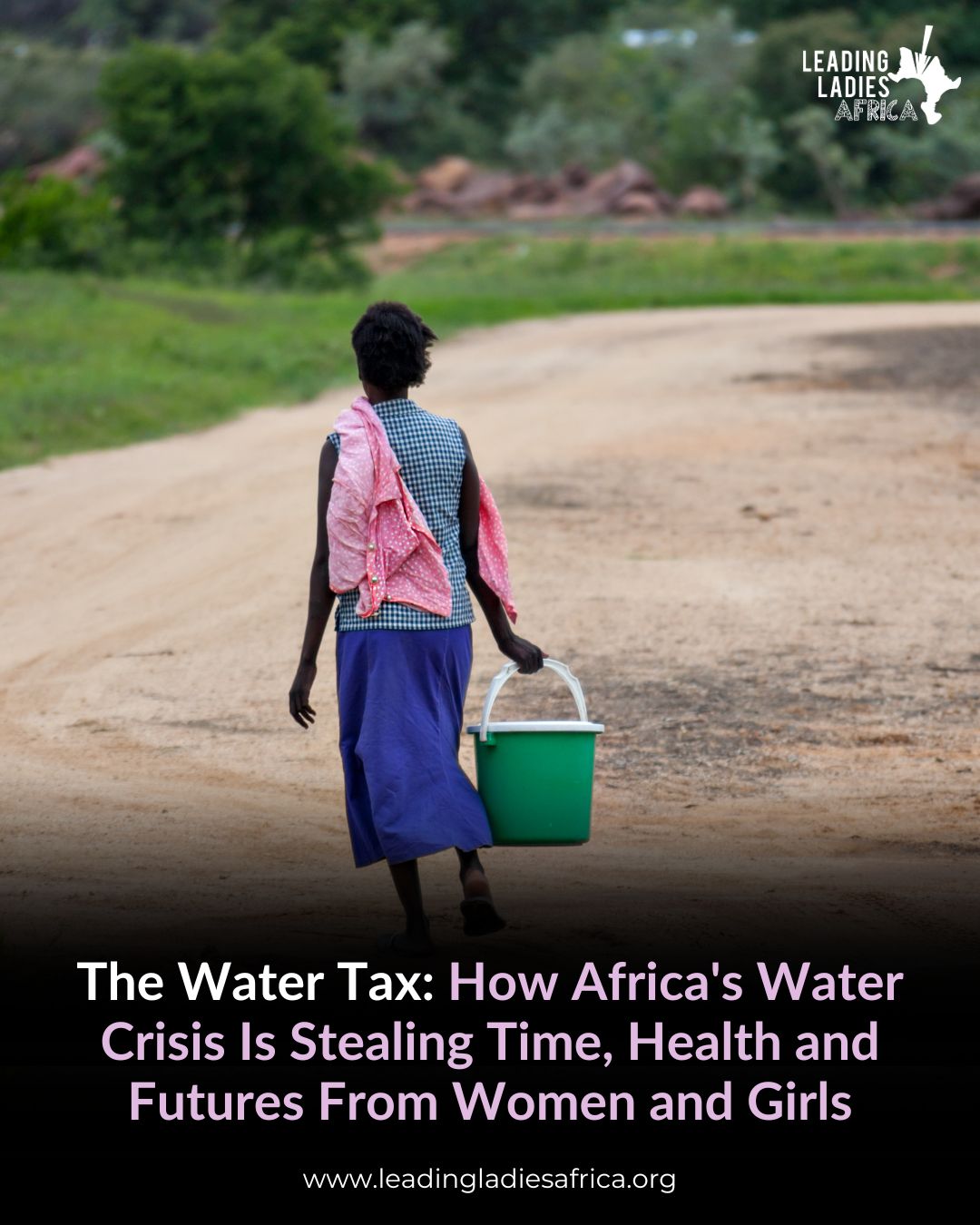
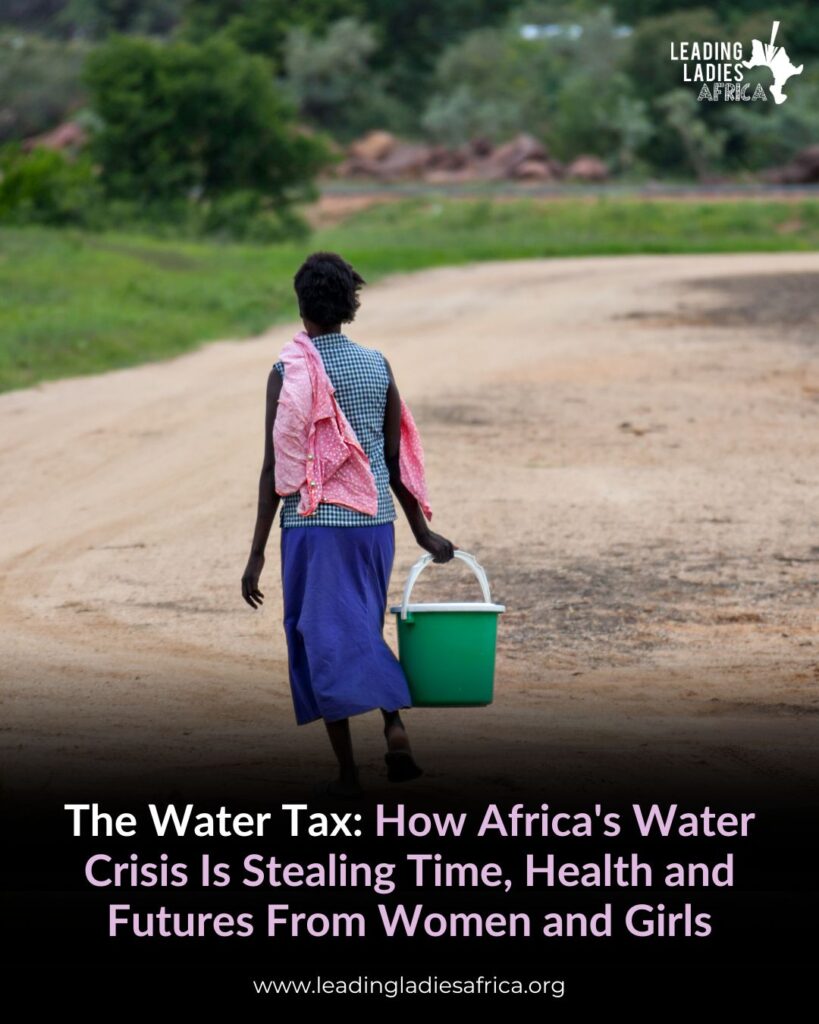
In nearly 80% of households across sub-Saharan Africa without piped water, the work of collecting water falls to women and girls. Not because they chose it. Because it was assigned to them — by social norms, household hierarchies, and a water infrastructure deficit that has never been adequately addressed. Before school. Before breakfast. Sometimes before sunrise. A girl picks up a jerrycan and starts walking. She will do this today. She did it yesterday. She will do it tomorrow. And nobody is counting what it costs her.
This piece is about making that cost visible.
The Scale of the Crisis
Over 411 million people across Africa cannot access safe drinking water. The Democratic Republic of Congo, a country sitting on some of the world’s largest freshwater reserves, has 89% of its population unable to access safely managed drinking water, a product not of scarcity but of conflict and infrastructural collapse. In Niger, 54% of citizens lack clean water. In Uganda, 51%. In the Horn of Africa, prolonged drought has pushed over 8.5 million people, including 4.2 million children, into extreme water shortage. In Eastern and Southern Africa alone, 281 million people lack basic drinking water, with over 82% of the underserved population concentrated in just eight countries, the DRC, Ethiopia, Tanzania, Kenya, Uganda, Madagascar, Angola, and Mozambique.
These are not uniform failures. They are the cumulative result of decades of underinvestment, poor governance, and the systematic exclusion of the people most affected from the decisions about how to address them.
And in almost every household affected by this crisis, a woman or girl is the one who goes to find the water.
200 Million Hours Every Day
Women and girls are responsible for water collection in nearly 80% of sub-Saharan African households without piped water. Girls are nearly twice as likely as boys to carry this responsibility. Women walk miles and spend anywhere from thirty minutes to several hours per trip, making multiple trips daily. Across the continent, women collectively spend an estimated 200 million hours every single day collecting water.
Two hundred million hours. Every day. That number needs to be held still for a moment, not as a statistic to be read and moved past, but as a representation of what is actually happening to real women in real time. 200 million hours of labour, performed daily, without pay, without recognition, and almost entirely without the people performing it having any meaningful say in the policies that would reduce or eliminate the need for it.
This is the water tax. Invisible, compulsory, and paid almost entirely by women and girls.
The Education Cost
Every hour spent fetching water is an hour not spent in school. This is not a metaphor. It is a documented, measurable reality playing out in communities across the continent where girls miss school because water collection cannot happen without them, not occasionally, but routinely, structurally, as a feature of how their households function.
Girls are pulled out of class to make afternoon water runs. They arrive late after early morning journeys to distant water points. They fall behind. They get pulled out entirely. The water crisis is one of the quietest drivers of girls’ dropout rates in Africa, and it almost never appears in the education conversation. We ask why girls are not completing school. We rarely ask what they were doing instead.
And when girls do make it to school, the crisis follows them there. Across the continent, millions of schools have no functioning water or sanitation facilities. For girls managing their periods in schools without water, private toilets, or disposal facilities, menstrual hygiene is nearly impossible. The girls who cannot manage it quietly remove themselves rather than face the humiliation of trying. The water crisis and the period poverty crisis are the same crisis, playing out simultaneously in the same schools, in the same bodies, and generating the same outcome, girls out of class, falling behind, dropping out.
The Safety Cost
The route to water is one of the most documented sites of violence against women and girls on this continent. Remote water points, poorly lit paths, early morning journeys before the community is awake, the conditions of water collection consistently expose women and girls to harassment, physical attack, and sexual assault. This is not anecdotal. It is documented, reported, and chronically underaddressed in water policy conversations that focus on access without considering what access looks like in practice for a woman walking alone before sunrise.
She is not just going to get water. She is navigating risk to get it. And she does it every day, because there is no other choice.
The Health Cost
Carrying heavy jerrycans over long distances, repeatedly, daily, over years, causes chronic back pain, joint damage, spinal injuries, and reproductive complications. These are predictable, documented consequences of asking women’s bodies to transport water as a matter of daily survival. The health system eventually pays for the damage, in communities where health systems are accessible. Nobody counts the cost of the labour that caused it.
The water itself extracts a parallel health cost. Scarcity forces reliance on contaminated sources. Waterborne diseases such ass cholera, diarrhoea, and acute respiratory infections, claim over one million lives in Africa every year. Women, as the primary handlers of household water, collecting it, preparing food with it, caring for the sick, cleaning are among the most consistently exposed.
The Economic Cost
Sub-Saharan African nations lose an estimated 5% of their annual GDP every year to inadequate water, sanitation, and contaminated supplies. That figure captures infrastructure costs, productivity losses, and healthcare burdens. What it does not capture is the value of 200 million hours of women’s daily unpaid labour, the invisible subsidy that makes the crisis survivable and simultaneously makes its true cost impossible to see.
Women who spend hours collecting water are not spending those hours on income-generating activities. They are not farming, trading, running businesses, or participating in formal employment in those hours. The economic potential of women across this continent is being actively constrained by a crisis that is treated as a water problem rather than a gender problem and the women absorbing the cost are receiving neither credit nor compensation for doing so.
The Policy Cost
Here is where the injustice becomes almost circular. The people who carry the water are not the people who decide where it comes from, how it is distributed, or who gets it.
Only 17% of national water ministries in Africa are headed by women. Just one of eleven international organisations managing shared African water basins is led by a woman. Women make up only 18% of the formal water and sanitation workforce globally, and just 23% of engineering and management roles. In agriculture, where women across Africa represent between 43% and 52% of the workforce and manage up to 80% of food production, they are systematically locked out of irrigation management committees and local water allocation decisions because only 15% of agricultural landholders are women.
The people who understand water scarcity most intimately, who have walked every step of its cost in their bodies and in their daughters’ interrupted educations, are almost entirely absent from the rooms where decisions about how to solve it are made.
This is not incidental. It is structural. And it has consequences. Research by the World Resources Institute on water projects across communities in Kenya, Ethiopia, and the Sahel shows that when women are actively included in shaping water policies, local systems function longer, access expands more quickly, and emergency water is shared more equitably. Inclusion is not a concession. It is a technical and governance improvement with documented, measurable outcomes. And it is still not happening at scale.
What African Women’s Day Demands
On African Women’s Day, we name the tax that nobody names. The hours before sunrise. The walk through risk. The back pain that builds over decades. The school days missed. The income never earned. The policy meetings never attended because the morning was already spoken for.
The water crisis is not a background issue sitting separately from conversations about gender equality, education, economic empowerment, and the safety of women and girls in Africa. It is at the intersection of all of them. You cannot close the gender gap in education while girls are missing school to fetch water. You cannot protect women from violence while sending them on dangerous daily journeys alone. You cannot unlock women’s economic potential while their hours are consumed by unpaid water labour. And you cannot solve the water crisis with policies made in rooms where women are not present.
African women deserve to be at the centre of every decision about how this crisis is addressed, not as beneficiaries of solutions designed without them, but as the architects of solutions built from their own lived knowledge of what the problem actually costs. Put them in the policy rooms. Fund the organisations they are already building. Count their labour. And give them back what that walk has been costing them all these years.