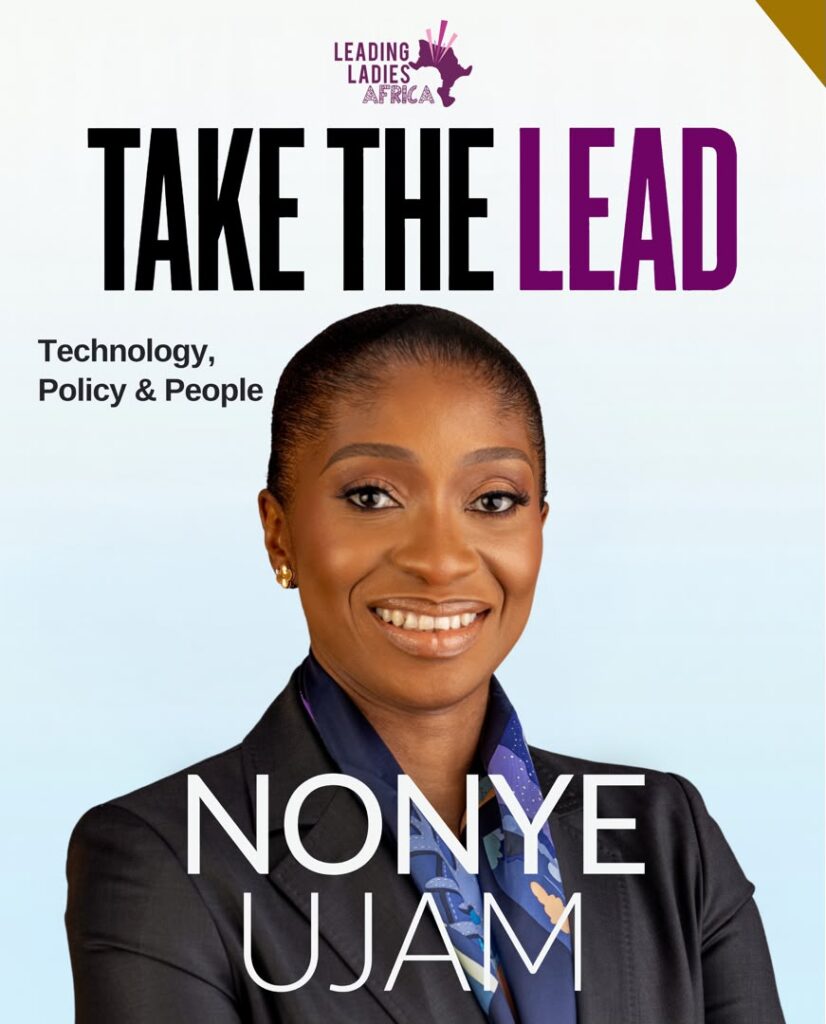
Nonye Ujam has never believed that technology, policy, development, and business belong in separate lanes. She has spent 19 years proving they do not have to be.
Her career reads like a deliberate refusal to be defined by any single discipline. She trained as a computer scientist, built expertise in IT law and management at King’s College London, earned a Master’s in Global Development Practice from Harvard, where she was awarded the Dean’s Prize for Outstanding Capstone for her work on improving access to basic education in Nigeria, and has worked across information security, development finance at the Central Bank of Nigeria, government advisory roles on the Sustainable Development Goals, and now, as Director of Government Affairs at Microsoft West Africa.
At Microsoft, Nonye leads strategic partnerships with governments, regulators, and multilateral organisations across West Africa, working at the intersection of digital transformation, AI governance, cloud adoption, policy, and regulation. Her mandate is not simply to represent a technology company. It is to build the bridges between technology and the people those systems are supposed to serve.
The thread that runs through every chapter of her career? Trust. How we build systems that people can participate in confidently. How we create the safeguards that allow those systems to scale responsibly. And how we ensure that the most transformative technologies of our time are deployed in ways that are equitable, inclusive, and genuinely beneficial.
In this conversation, Nonye opens up about what she has learnt across 19 years of building at the intersection of technology and development, what Africa is losing every day it is not meaningfully at the AI table, why digital sovereignty matters to every woman even if she has never heard the term, and what she wants every young woman deciding right now whether technology and policy is a space she belongs in to know.

Most people pick a lane, technology or policy, development or business. You have spent 19+ years refusing to separate them. Who are you at your core, and what has always driven that refusal?
At my core, I am a problem solver driven by the desire to create meaningful impact at scale. My training as a computer scientist taught me to understand systems: how they work, where they break down, and how they can be improved. Over the past 19 years, that way of thinking has shaped how I approach leadership across technology, policy, business and development.
I have never seen these fields as separate lanes. I see them as interconnected levers for progress. Technology can unlock new possibilities, business can create sustainable pathways to scale, and policy can create the enabling environment for transformation. Real change happens when these forces work together.
What has always driven me is a belief that innovation only matters if it improves people’s lives. Whether I am working on technology adoption, digital policy, skills development or economic opportunity, my focus is ultimately the same: bringing together ideas, people and institutions to build systems that serve people and create lasting impact.
You started your career in the UK, returned to Nigeria to join the Central Bank, were party to designing national financial inclusion programmes, and now lead government affairs at Microsoft West Africa. What has moving across those very different institutions taught you about where real change actually happens?
The biggest lesson has been that real change rarely happens within a single institution. It happens at the intersection of institutions, when governments, businesses, academia, civil society and development partners align around a shared objective.
Moving across the UK, the Central Bank of Nigeria, government-facing roles and Microsoft has shown me that each part of the ecosystem brings a different strength. Governments create the enabling environment and legitimacy to scale. The private sector brings innovation, investment, speed and execution. Development partners often provide the patient capital and long-term perspective needed to sustain progress. None can achieve transformational change alone.
I have also learnt that transformation is built long before it appears in a headline. It happens through the people and partnerships that turn vision into implementation, policy into action, and ambition into measurable outcomes. The most successful initiatives I have seen were not driven by a single organisation, but by coalitions that aligned incentives, combined capabilities and stayed focused on the end goal.
Ultimately, lasting impact comes from building bridges, not silos. Real change becomes possible when diverse stakeholders work together to make progress practical, scalable and sustainable.
You have spent 19+ years working at the intersection of technology, policy, and development. What do most people in the technology industry still fundamentally misunderstand about what it takes to make digital transformation work for ordinary people?
One thing the technology industry sometimes misunderstands is that digital transformation is not primarily a technology challenge. It is a people, infrastructure and trust challenge.
Technology can be excellent, but whether it reaches and improves the lives of ordinary people depends on a much broader ecosystem. Adoption is shaped by affordability, connectivity, reliable electricity, digital identity, skills, language and, critically, trust. These are challenges that no single organisation can solve alone, which is why collaboration across government, industry, civil society and development partners is so important.
Meaningful digital transformation starts with understanding the realities of the people we are designing for and the problems we are trying to solve. When we build with those realities in mind, technology moves beyond access to become genuinely useful and impactful.
Over the years, I have learnt that success is not always measured by how sophisticated the technology is. It is measured by whether a small business can reach new customers, whether a farmer can access better information, whether a student can acquire new skills, or whether a citizen can access essential services more easily.
When ordinary people experience tangible improvements in their lives, that is when digital transformation has truly succeeded.
You lead strategic partnerships with governments, regulators, and multilateral organisations across West Africa. What does it actually take to move those conversations from agreement in principle to real, implemented change on the ground?
It takes more than an agreement. It takes alignment, capacity, sustainability and commitment over time.
First, partnerships should align with priorities that governments already own and are working to achieve. The strongest collaborations build on national strategies and shared ambitions because that creates the foundation for genuine ownership and long-term impact.
Second is institutional capacity. An agreement is only as effective as the institutions and people responsible for implementing it. That is why capacity building is such an important part of the work we do. It is about strengthening the skills, systems and structures that turn commitment into action. For instance, our partnership with the Nigeria Data Protection Commission focused on building practical capabilities in data protection, privacy, cybersecurity and AI governance to support effective implementation of the Nigeria Data Protection Act.
Third is sustainability. The strongest partnerships are designed to outlast the individuals who initiated them. They create ownership, strengthen institutions and establish frameworks that continue delivering value long after the initial intervention. That to me is the true measure of partnership, not simply what is achieved today, but what is enabled for tomorrow.
Finally, presence matters. Transformation rarely happens as quickly as people expect. It requires patience, clear accountability, measurable milestones and partners who continue to show up, listen, adapt and build together. In my experience, that consistency is often the quiet force that turns shared ambition into lasting change.
Ultimately, implemented change happens when partnership moves beyond signing agreements to strengthening the institutions, capabilities and relationships needed to sustain progress over time.

Your career spans IT security, development finance, policy advisory, and now AI governance at a global technology company. What thread runs through all of those chapters, and how has each one sharpened the way you see the next?
The thread that runs through every chapter of my career is trust: how we build systems that people can participate in confidently, and how we create the safeguards that allow those systems to scale responsibly.
Information security taught me to think deeply about risk, resilience and protection. Development finance expanded that perspective to inclusion, asking how we bring more people into economic systems while ensuring that progress does not create new vulnerabilities.
My experience in government reinforced that lasting change depends not only on good ideas, but also on institutions, policy frameworks and stakeholder alignment. Even the best solutions struggle to scale if the enabling environment is not created.
AI governance brings all of those lessons together. It requires us to balance innovation with responsibility, opportunity with inclusion, and speed with trust. The challenge is not simply to develop powerful technologies, but to ensure that they are deployed in ways that are safe, equitable and beneficial to society.
Each chapter has broadened how I think about the next. Today, I see responsible innovation not as a constraint on progress, but as a prerequisite for sustainable progress. In my experience, the technologies that create the greatest long-term impact are the ones that people trust enough to adopt, institutions trust enough to support, and societies trust enough to scale.
There is a real risk that Africa becomes a consumer of AI rather than a creator of it. What policy and infrastructure decisions need to happen right now to change that trajectory, and who needs to be making them?
Africa has already made significant progress, with stronger digital ecosystems, a growing technology talent base, increasing local innovation and greater recognition of AI as both an economic and development opportunity. The priority now is to accelerate that momentum so Africa continues to move beyond adoption toward building and shaping the future of AI.
That requires sustained foundational investment – reliable energy supply, affordable connectivity and access to compute are essential, but access to high-quality data is equally critical. For instance, if African languages, accents, healthcare realities, agricultural conditions and local contexts are not sufficiently represented in the data that shapes AI systems, those systems will be less effective for the people they are meant to serve. We therefore need greater investment in local-language and sector-specific datasets, alongside clear frameworks for data governance and shared value.
There is also a strong case for greater continental cooperation around data infrastructure. Just as Africa has benefited from shared digital and financial platforms, we should be thinking about creating regional or continental data ecosystems that can serve as shared services for governments, researchers, startups and businesses. These data embassies or trusted cross-border data infrastructure models could help countries pool resources, improve resilience, responsibly share data and give African innovators access to the scale needed to train, test and deploy solutions that reflect African realities.
At the same time, Africa should be deliberate about building on its comparative advantage. While the continent may not immediately match the largest economies in compute capacity, it has one of the world’s youngest and fastest-growing talent pools. The opportunity is not only to develop AI for Africa, but also to position Africa as a key supplier of the global AI workforce, from researchers and engineers to policy specialists, data scientists and digital entrepreneurs. Investing in education, skills development, research institutions and innovation ecosystems today can enable Africa to power a significant share of the world’s future digital workforce.
Talent and research capacity must grow alongside this infrastructure, creating stronger pathways for academia, entrepreneurs and local innovators to build and scale solutions. This is a collective effort across governments, technology companies, regulators, academia, investors and development partners. Africa already has many of the critical ingredients; the opportunity now is to connect them, with intentionality, and create the conditions for African innovators to build for the continent and for the world.
Digital sovereignty is becoming one of the most important conversations in African technology policy. For the woman reading this who has never heard that term, why should she care, and what does it have to do with her life?
At its simplest, digital sovereignty is about trust, control and resilience: who has control of the data, who can access it, and under whose laws it is governed.
That matters because our most sensitive information – financial records, health data, identity information, public services – now lives increasingly in digital systems. The question is not really about where that data sits, but whether governments and institutions can protect it, govern it responsibly and continue delivering essential services even when circumstances change.
My perspective is that digital sovereignty is not simply about where data is located. It is about whether countries have the legal, technical and institutional capacity to protect their interests, manage risk and participate confidently in the global digital economy. The goal should be to balance access and innovation with security, accountability, legal certainty and national resilience.
And importantly, data sovereignty is strengthened by strong infrastructure, clear regulation, capable institutions and skilled people.

AI policy is being written right now, in rooms that do not always include African voices. What is Africa losing every day that its governments are not meaningfully at that table?
Africa has an important voice in the global AI conversation, and we are seeing growing participation from governments, regulators, researchers and technology leaders across the continent. We must continue to make that participation even more coordinated, confident and influential.
AI governance must reflect the realities of different markets. For Africa, that means ensuring global conversations consider not only risk, but also inclusion, access, economic opportunity and the transformative potential of AI in key sectors like healthcare, education, agriculture and financial services.
It also means contributing to the standards themselves, bringing African perspectives, evidence and expertise into how responsible AI is defined and implemented globally.
Again, Africa represents one of the world’s youngest and fastest-growing populations. Our role should therefore extend beyond responding to frameworks created elsewhere. We have an opportunity to help shape the principles, standards and models that will govern AI for the future.
What do women specifically need to understand about AI, not as users of the tools, but as people who should be shaping how those tools are built, governed, and deployed?
One of the most important things to understand about AI is that many of the decisions that shape its impact happen long before a tool reaches the user. They happen in how data is collected, what systems are designed to optimise for, how risk is assessed, and how technology is governed, procured and deployed.
That is why women’s participation across the entire AI ecosystem is so important. AI systems reflect the choices, assumptions and data that go into them. A credit model, for example, can reproduce historical inequities if the data behind it does not adequately reflect women’s experiences and realities. The same is true across healthcare, employment, financial services and many other sectors.
My encouragement to women is to see AI as a space to shape, not simply a technology to use. We need women contributing across engineering, research, policy, regulation, procurement, governance and leadership. You do not have to be an engineer to influence how AI develops, but building the confidence and fluency to engage in these conversations is increasingly important.
Ultimately, the question is not whether women will be affected by AI, because they will. The question is whether women are sufficiently represented in the rooms where the decisions about AI are being made. We need more women helping to define the future of this technology, not simply adapting to it.
Beyond the research, the partnerships, and the policy wins, what do you want the name Nonye Ujam to stand for, for every young woman who is deciding right now whether technology and policy is a space she belongs in?
I would like it to stand for the proof that she does not have to choose. To stand for possibility, the idea that a woman can build a career that is ambitious, multidimensional and deeply rooted in who she is. My journey has spanned different sectors and disciplines, while I have also raised four children. I share that not as a blueprint, but as evidence that there is more than one way to build a meaningful life and career.
I would also like it to stand for leadership grounded in both competence and humanity. Women should not feel they have to become someone else to lead effectively. Expertise, preparation and credibility matter, but so do empathy, authenticity and the ability to take people along with you.
Most importantly, I would like it to stand for opening doors. None of us succeeds alone, and every opportunity creates a responsibility to widen the path for others. If a young woman sees my journey and believes she belongs in the rooms where technology, policy and the future are being shaped, then I hope she walks into those rooms with confidence. And when she does, I hope she leaves the door open for the woman coming behind her.
That, to me, would be a legacy worth having.