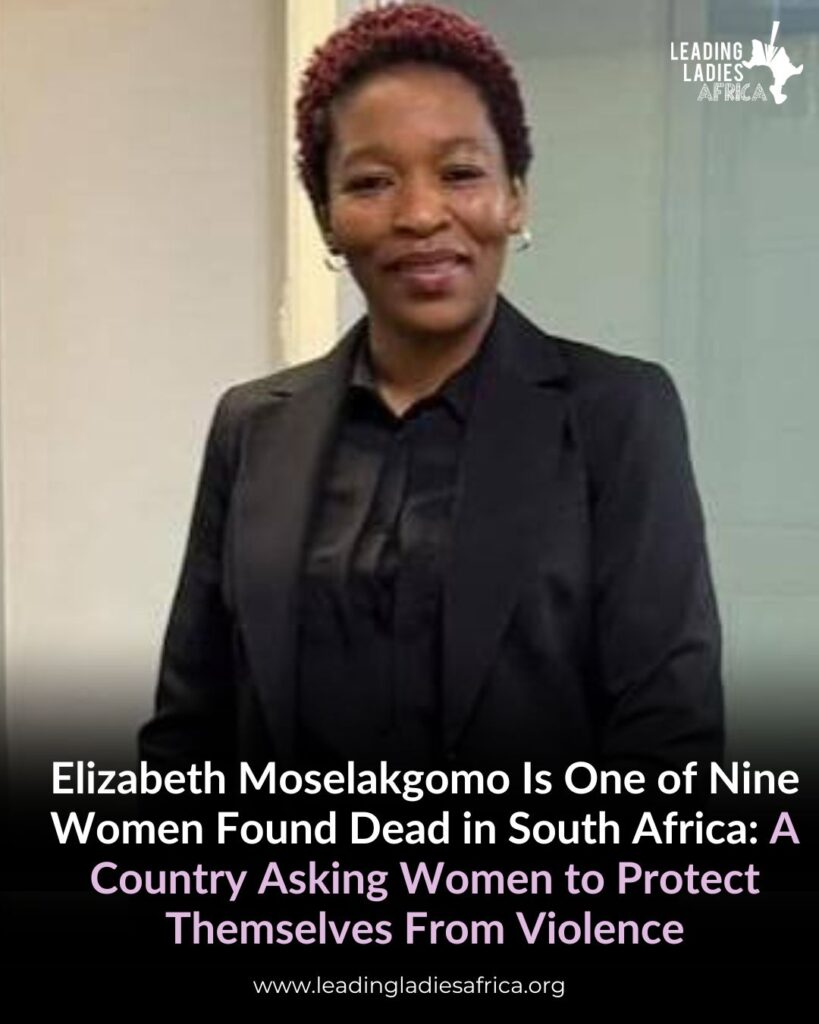
On September 10, Elizabeth “Tsontso” Moselakgomo left her home in Rhodesfield, Kempton Park, for a run. It was an ordinary thing to do. Elizabeth was 38. She was a mother, a runner, a daughter, a friend, a woman with a life that extended far beyond the few hours she would spend on a familiar route. She had recently completed the Wanderers 21km race. She belonged to a running community. She had an eight-year-old daughter waiting for her at home. By 6:30 that evening, her daughter realised her mother had not returned. She raised the alarm.
Two days later, Elizabeth’s body was found near York Street in Rhodesfield. She had been badly bruised and was partially clothed. Her family later identified her body. She should have come home. Instead, her death became part of a much larger and deeply disturbing investigation.
As of September 18, police were investigating the deaths of nine women whose bodies had been discovered across Ekurhuleni since July, including in Kempton Park, Rhodesfield, Olifantsfontein, KwaThema, Springs and Dawn Park. Several of the women were found naked or partially clothed and with signs of violence. Six of the nine bodies were reportedly discovered within a single week.
Police have said the similarities between some of the cases are “sufficiently concerning” to warrant a high-level investigation and public warning. But they have also been careful not to confirm that the deaths are connected or the work of one serial killer. Investigators are considering different possibilities.
That distinction matters, but so does this: Nine women are dead, and once again, women are being told to be careful.
Women Already Know How to Be Careful
Following the discoveries, police urged women in the affected areas to avoid walking or running alone, particularly in isolated places. Women have heard versions of this advice for years.
Do not walk alone. Do not run alone. Do not wear headphones. Share your location. Change your route. Avoid isolated areas. Make sure someone knows where you are. Stay in well-lit places. Run in groups. Carry an alarm. Keep your phone close.
The list is endless because women have been building their own safety systems for as long as they have had to navigate a world where simply being outside can carry risk. Elizabeth was a runner. She was not unaware of safety. Neither are the women who run in groups, share their live locations, check in with friends when they get home, change their routes and avoid certain streets after dark.
The women of South Africa are already doing the work, and they are still being killed. That is why the safety advice, while practical in the immediate sense, cannot be the end of the conversation. The question cannot always be what women should have done differently. It has to be why women are being placed in situations where ordinary activities require this much calculation in the first place.
As one runner, Keamo Sefularo, told the BBC after Elizabeth’s death: “Women are not free if we have to calculate where, when and with whom we can walk, run or exist safely.”
That is not freedom.
Elizabeth Did Not Cause Her Own Death
There is something particularly painful about what happens after a woman is killed. The conversation often moves quickly to what she could have done to prevent it. She should not have been alone. She should have taken another route. She should have told someone. She should have been home earlier. She should have carried something for protection. She should have known better, but Elizabeth did not cause her own death by going for a run.
The responsibility for violence belongs to the person who commits it. And the responsibility for preventing, investigating and prosecuting violence cannot be transferred wholesale onto women simply because institutions have not yet made public spaces safe enough.
This is not an argument against women taking precautions. It is an argument against pretending that precautions are a substitute for prevention.
Women can run in groups and still be attacked. Women can share their locations and still disappear. Women can avoid headphones and still be killed. Women can change their routes every week and still encounter violence.
There is no safety checklist capable of compensating for a system that cannot reliably prevent violence, respond to missing women, investigate killings and bring perpetrators to justice.
Elizabeth Was Not a Statistic
It is easy to talk about nine women. Numbers help us understand scale, but numbers can also flatten lives. Elizabeth was not “victim number X.” She was Tsontso.
She was a woman her running community knew as light-spirited, funny, joyful and kind. She was a mother whose eight-year-old daughter noticed her absence and raised the alarm. She had routines, relationships, people who expected to see her again.
Now her daughter will have to grow up knowing that her mother left home for something as ordinary as a run and never came back, and Elizabeth is not the only family facing that reality.
Police have confirmed that only some of the nine women have been identified. For the families of those who remain unidentified, there is another devastating question: Who is missing?
A woman cannot be fully mourned if nobody knows her name.
Her family cannot bury her. Her children cannot understand what happened. Her friends cannot say goodbye.
Nine bodies are nine lives interrupted. Nine families altered. Nine communities carrying questions that may take months or years to answer.
Nine Women Had to Die Before the Urgency Became Visible
The state has now responded with significant police resources. A multidisciplinary task team has been established. Police have increased operations and visibility in affected areas, while authorities have issued public warnings. A reward has also been offered for information that could assist investigators. President Cyril Ramaphosa has pledged that the investigation will receive urgent attention.
Those actions matter, but they also raise an uncomfortable question: why does urgency become easier to see after the bodies begin to accumulate?
The running community has pointed out that some of the earlier deaths were not widely known until Elizabeth disappeared and her case received widespread attention. That matters because prevention is supposed to happen before a woman becomes a headline.
A missing woman should not have to become nationally known before people start asking where she is. A community should not have to discover multiple bodies before an area receives heightened attention. Women should not have to die in numbers before the machinery of the state moves with urgency.
The Commission for Gender Equality has called for safety audits in affected areas, including assessments of lighting, surveillance, pedestrian routes, public transport, neglected spaces, police visibility and access to emergency assistance. Its argument is straightforward: women should not have to be killed before an area receives heightened attention.
That is what prevention looks like. It is not only responding when there is already a body. It is identifying the conditions that make violence easier to commit and harder to prevent — and changing them before another family has to identify another body.
South Africa Does Not Lack Warnings. It Lacks Consistent Implementation.
South Africa has laws, strategies, institutions and national commitments aimed at addressing gender-based violence and femicide. In November 2025, the country classified gender-based violence and femicide as a National Disaster. Parliament has since raised questions about how the response will be funded and operationalised. Yet experts and advocacy organisations continue to point to the gap between what exists on paper and what women experience in reality.
Research cited by UN Women has documented the country’s persistently high femicide rate. Parliament reported in February 2026 that South Africa’s femicide rate stood at 9 per 100,000 women, five times the global average.
The problem, then, is not simply whether South Africa knows that violence against women is a crisis. It does. The problem is whether the systems designed to respond to that crisis work consistently enough to prevent women from becoming its next victims.
That means properly resourced policing. It means investigations that move. It means functioning courts. It means survivor support. It means shelters and social services that are accessible. It means coordination between institutions. It means consequences when perpetrators are identified, and it means treating a missing woman as an urgent matter before she becomes a murder case.
As researcher Lisa Vetten told the Mail & Guardian, the challenge is not simply the existence of laws and policies, but whether the state has the capacity and resources to implement them through functioning police services, courts, shelters, social workers and victim-support systems.
That is the gap that women cannot afford to live inside.
This Crisis Is Bigger Than Kempton Park
Elizabeth’s death has happened in one municipality, but the fear it has triggered is recognisable far beyond Ekurhuleni. Women across South Africa know what it means to text someone when they get into a taxi.
To share a live location. To call someone while walking home. To look over their shoulder. To cross the road when a man approaches. To decide whether a particular street feels safe. To calculate how late is too late. To ask someone to accompany them somewhere they should have been able to go alone.
This is what living under threat does. It turns ordinary movement into risk management, and that is why Elizabeth’s death has resonated so deeply with runners. Across South Africa, running clubs have organised memorial runs and dedicated distances to Elizabeth and other women who have been killed. Runners have taken to the streets not simply to mourn her, but to confront the fear that now follows them on routes that once felt ordinary.
They are mourning a woman who loved running, but they are also mourning the freedom to run without wondering whether they will make it home.
We Cannot Keep Asking Women to Organise Their Lives Around Violence
There is a difference between telling women how to stay safe and building a society in which women are actually safer. The first places the immediate burden on the individual. The second demands action from everyone with the power to change the conditions around her.
Women can take precautions. Communities can look out for one another. Running clubs can organise group runs. Families can check in. Friends can share locations, but these things cannot become substitutes for institutional responsibility.
Women for Change has criticised the idea that women should have to protect themselves against violence that institutions are supposed to prevent. Lawyers for Human Rights has similarly pointed to failures in policing, legal processes, support services and coordination as barriers to an effective response to GBV. The responsibility for addressing gender-based violence cannot be outsourced to women, and it cannot be outsourced to running clubs, WhatsApp groups, neighbourhood watches or terrified mothers teaching their daughters which streets to avoid.
Communities can support women. They cannot prosecute perpetrators. They cannot run forensic investigations. They cannot fix broken systems. They cannot make policy implementation work. They cannot guarantee that a missing woman will be found alive. Those responsibilities belong to institutions with the authority and resources to act.
Elizabeth Should Have Come Home
Elizabeth’s story began with a run. It ended with an eight-year-old girl asking where her mother was. That should be enough to make us angry. But it is not only Elizabeth’s story. It is the story of nine women whose bodies have been found across Ekurhuleni. It is the story of families still waiting to identify loved ones. It is the story of women who are now reconsidering how they move through their own neighbourhoods. It is the story of runners who have turned their grief into memorial runs because they refuse to allow fear to take the streets from them, and it is part of a much older story in South Africa, one in which gender-based violence has been recognised repeatedly as a national crisis, while women continue to experience its consequences in their homes, communities and public spaces.
We do not need to know yet whether these nine deaths were committed by one person, several people or people acting independently to know that something is deeply wrong. We know nine women are dead. We know women are afraid. We know women have already been taking precautions. We know South Africa has laws and national strategies intended to address gender-based violence, and we know experts and rights organisations continue to identify serious gaps in implementation and institutional capacity.
So the conversation cannot end with another warning telling women to be more careful. It cannot end with another press conference. It cannot end with another task team formed after another body is found, and it cannot end when the outrage on social media fades.
Elizabeth Moselakgomo should have come home. So should the other eight women. Their deaths demand more than our horror after the fact. They demand investigations that lead somewhere, institutions that work before tragedy strikes, public spaces designed with women’s safety in mind, and accountability that does not disappear when the headlines do.
Because women have been careful. They have been vigilant. They have changed their routes. They have run in groups. They have shared their locations. They have warned one another, and they are still being killed.
Elizabeth should have come home. Nine women should still be alive, and South Africa cannot keep asking women to do more to survive a violence they did not create.