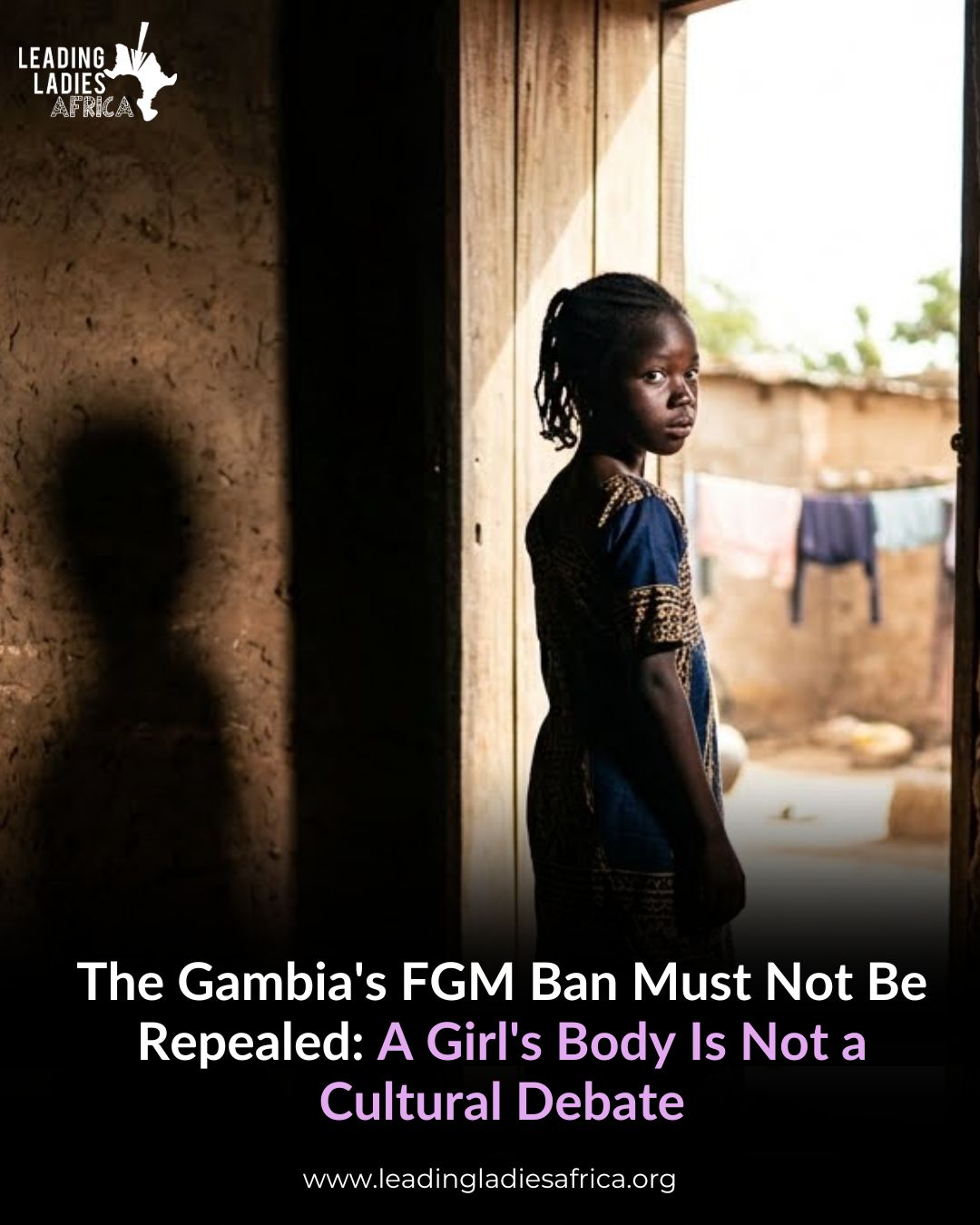
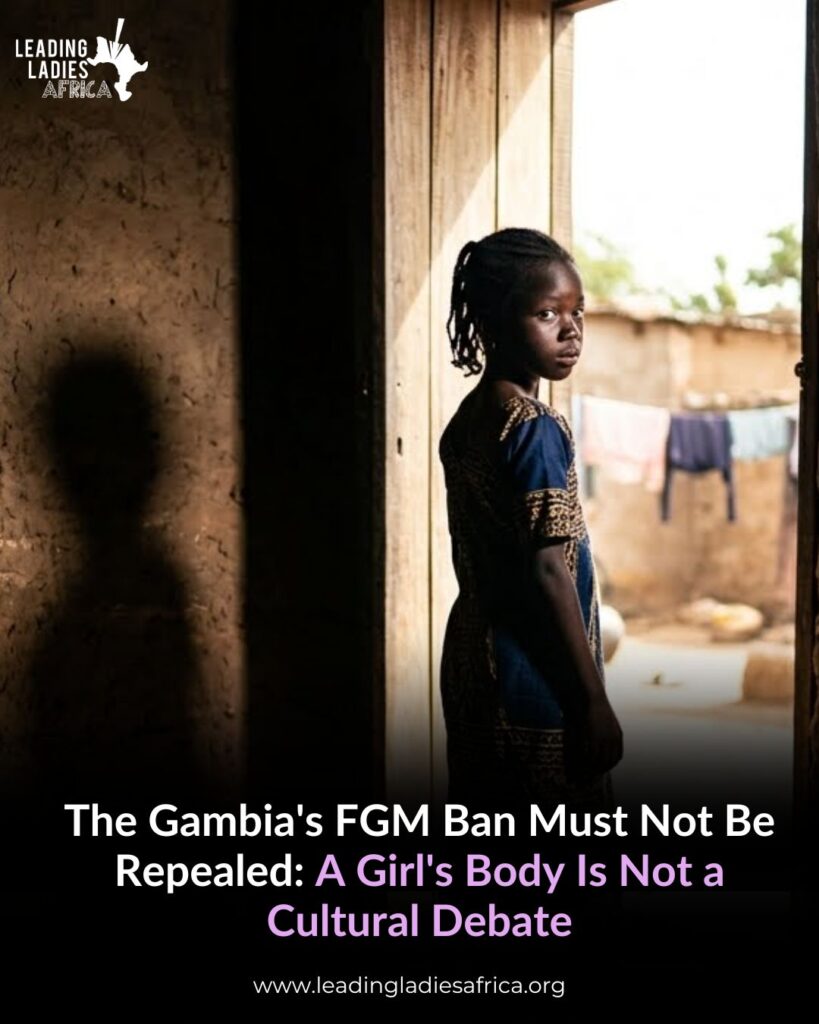
The Gambia’s Supreme Court is currently weighing whether to uphold or strike down the country’s 2015 ban on female genital mutilation. The case was brought by religious leaders and a member of parliament who failed to repeal the ban through parliament in 2024 and have now taken their fight to the highest court in the land. They argue that the ban violates constitutional rights to cultural and religious freedom. The court’s ruling could come at any time. What it decides will determine whether the girls of The Gambia are protected by law or handed back to a practice that has already cost too many of them everything.
What FGM Actually Does
Before the legal arguments, before the constitutional framing, before the language of rights and culture and tradition, let us be precise about what is actually being debated here. What is FGM, and what does it do to a body?
FGM often involves forcibly restraining girls while parts of their genitals are cut, sometimes with the wound sewn shut. It is performed most commonly on infants and girls, frequently without anaesthesia. The immediate consequences include severe bleeding, infection, excruciating pain, and shock. The long-term consequences, carried in the bodies of survivors for the rest of their lives, include chronic pain, recurrent infections, complications during childbirth, fetal deaths, obstetric damage, sexual dysfunction, and deep, lasting psychological trauma. FGM constitutes torture and cruel, inhuman, or degrading treatment under international human rights law. It can result in death or lifelong health problems.
This is what some people in The Gambia are currently fighting to keep legal.
The 2015 Ban and What Came After
In 2015, The Gambia made a decision that mattered. The government passed a law criminalising FGM, carrying penalties of up to three years in prison and life imprisonment where the practice results in death. Almost 75% of women in the country have been cut, usually as infants. The ban was a hard-won legal protection in a country where the practice was not fringe but majority carried in the bodies of three in four women.
Enforcement remained limited. The first convictions under the law came only in 2023, when three women were found guilty of performing FGM on eight girls aged between eight and ten in the Central River Region. By 2024, only two cases had reached prosecution. The law existed. Its reach was imperfect. But it existed — and that foundation mattered.
Then, in early 2024, one lawmaker proposed a bill to reverse the anti-FGM law. His calls caused widespread outrage from activists and rights groups who said years of advocacy work would be wasted. The Gambia’s top religious body backed the repeal, though, and called FGM “one of the virtues of Islam.” On 15 July 2024, the National Assembly rejected the proposed Women’s Amendment Bill, which sought to decriminalise FGM. Civil society organisations had mobilised survivors, community leaders, and women’s groups across the country to fight it. They won that round.
But religious leaders and a member of parliament failed to get parliament to overturn Gambia’s 2015 FGM ban in 2024. They have taken their fight all the way to the Supreme Court, contending that the ban violates constitutional rights to cultural and religious freedom. And so the fight continues, in the country’s highest court, with everything still at stake.
A One-Month-Old Baby Died From This in 2025
The danger became painfully clear in August 2025 when a one-month-old baby girl reportedly bled to death after undergoing FGM. She was too young to speak, understand what was happening, and protect herself.
She was one month old. She died bleeding from a procedure performed on her body while the ban was in place, while the law existed, while the practice was criminal. Increasingly, it seems the 2015 ban has pushed those intent on continuing the practice to focus on cutting children earlier, as one-month-old infants. This is what the practice looks like when it is driven underground. This is what repealing the ban would bring back into the open, legally protected, with the full authority of a Supreme Court ruling behind it.
The Religious Freedom Argument Does Not Hold
The plaintiffs argue that the ban on FGM violates constitutional rights to cultural and religious expression. This argument requires a direct and clear response.
There is no requirement for FGM in Sharia (Islamic law). It is not part of the Sunna (Prophetic traditions) or considered an honourable act. The practice predates Islam and is not universal among Muslims, it is a cultural practice that some communities have incorrectly linked to faith.
Moreover, framing FGM as a constitutional right to religious freedom is misleading. The Gambian constitution restricts rights, including religious or cultural ones, that impinge on other people’s fundamental rights and freedoms, such as the right to life, freedom from torture or inhuman treatment, and non-discrimination.
A girl’s right not to have parts of her genitals removed without consent is a fundamental right. It is a right to life, to physical integrity, to freedom from torture. It does not yield to cultural preference or religious interpretation. The constitutional framework itself forecloses the argument being made.
The Women Fighting This Are Being Silenced for It
The opposition to the case is coming from women and girls whose lives literally depend on maintaining these protections. “This is happening despite individuals being harassed, particularly on social media, for speaking out against the case, creating an atmosphere where many survivors, including women’s rights defenders, are now choosing to be silent,” said Fatou Baldeh, an anti-FGM activist, FGM survivor, and founder of WILL.
This is not a balanced public debate happening on level ground. The women fighting for the ban are doing so while being targeted for it. The survivors speaking out are being harassed into silence. The activists defending girls are being intimidated while a court decides whether those girls will continue to have legal protection. That is the environment in which this ruling is being made. It matters.
The Gambia’s Own Commitments Make the Answer Clear
Gambia has ratified the African Charter on Human and Peoples’ Rights, its Protocol on the Rights of Women in Africa (Maputo Protocol), and the African Charter on the Rights and Welfare of the Child. Article 5(b) of the Maputo Protocol explicitly prohibits all forms of FGM and the medicalization of the practice. In July 2025, the government signed the African Union Convention on Ending Violence Against Women.
The Gambia has, through its own signatures and ratifications, told the continent and the world that it understands FGM to be gender-based violence. That it understands the Maputo Protocol’s prohibition to be binding. That ending violence against women is a commitment it has formally made. The Supreme Court ruling cannot exist in a vacuum. It exists within the full context of every agreement The Gambia has already entered into — agreements that leave no room for a ruling that strips girls of their legal protection.
This Is Part of Something Larger
This effort is not just a setback for one small West African country, it’s part of a global backlash against women’s rights that threatens to unravel decades of progress protecting women and girls from a widespread form of gender-based violence.
The attempt to repeal The Gambia’s FGM ban is not an isolated event. It is one node in a global pattern, of hard-won protections being challenged by those who have never had to live in the bodies those protections were designed to serve. Every time a country rolls back a legal protection for women and girls, it sends a message to every other country watching. Every time the backlash wins, the next attempt becomes easier. The Gambia’s Supreme Court ruling is not only about The Gambia. It is about what the continent decides is acceptable to do to girls.
The Court Must Uphold the Ban
The ban is not perfect. Its enforcement has been limited. The practice continues in secret and has been pushed to younger and younger children as a result. A one-month-old baby died from it last year. None of this is an argument for repeal, it is an argument for stronger enforcement, better community engagement, and deeper investment in the protection the law provides. Removing the legal framework does not solve the enforcement problem. It removes the floor that every other effort stands on.
The Gambia’s Supreme Court must uphold the 2015 ban. Not because the law alone ends FGM, it does not. But because a legal framework that says this is wrong is the foundation everything else must be built on. Remove it and you remove not just the law but the signal, the clear, enforceable statement that a girl’s body belongs to her, that what is done to it without her consent is a crime, that the state is on her side.
The Girls Are Watching. So Are We.
Mariama Jabbie is still under that mango tree in Wellingara, watching her daughters play. She was cut at the same age they are now. She knows what they do not yet know, that a court is deciding their future, that the law protecting them is under challenge, that the women who fought for that law are being harassed for defending it.
We stand with her. We stand with Fatou Baldeh and every survivor who has spoken at enormous personal cost to protect the girls coming after them. We stand with the girls themselves, the six-year-olds and the nine-year-olds and the one-month-olds who cannot yet speak for themselves.
Uphold the ban. Enforce it fully. Invest in the communities where the practice persists. And refuse, loudly, continentally, internationally, to allow a court ruling to hand girls back to a practice that constitutes torture, that kills, and that has already cost three in four Gambian women something they can never get back.
The world is watching. The girls cannot wait. Lend your voice to uphold the ban and sign this petition.