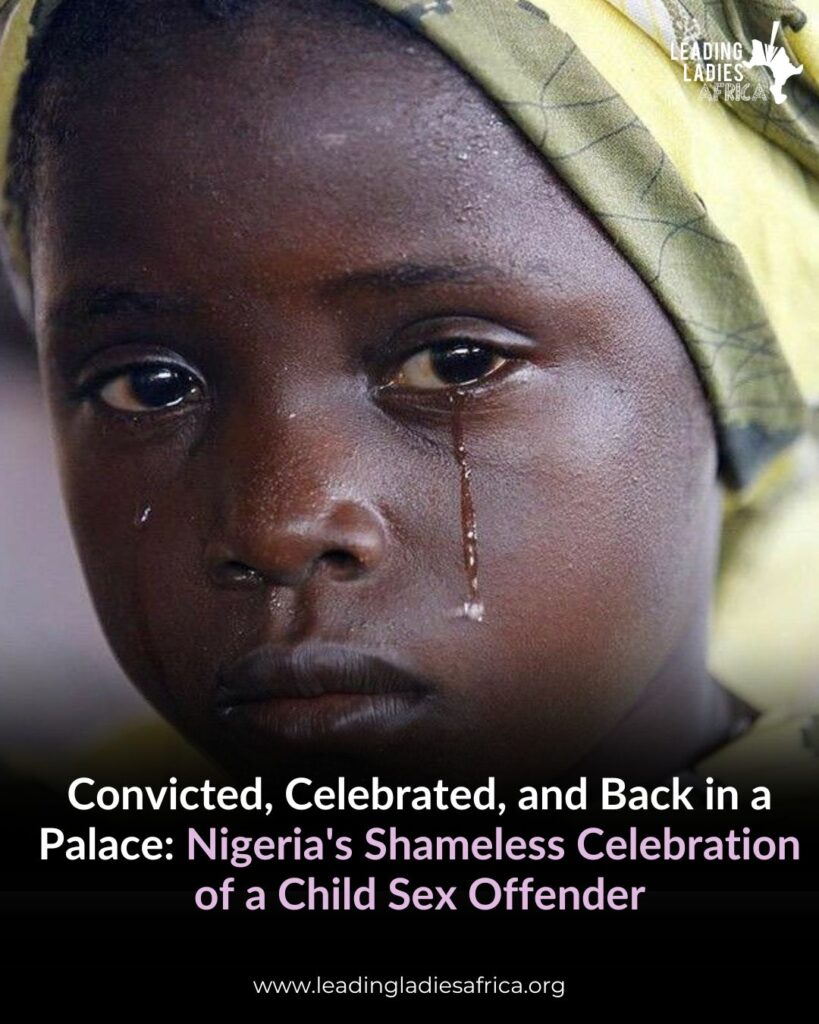
Baba Ijesha — Olanrewaju James, Nollywood actor, convicted child sex offender, registered on the Lagos State sex offenders register, conviction upheld by the Supreme Court of Nigeria, visited the palace of the Ooni of Ife. He sat with one of the most revered traditional rulers in Yorubaland. He left with a brand new car and cash gifts. The Ooni’s Palace, responding to the eruption of public outrage that followed, issued a clarification, no chieftaincy title was formally conferred. The phrase he had posted on social media as a title was a joke, a casual remark made during a relaxed interaction. It was not an installation. It was not a ceremony but the palace also confirmed everything else. The reception. The car. The cash. Given, they explained, out of royal generosity and fatherly love, to celebrate his new marriage and the birth of his son.
Fatherly love. For a man who sexually assaulted a child from the age of seven. We need to sit with that for a moment.
What He Actually Did
This is not a story about allegations. It is not a story about public opinion or industry politics or the complications of celebrity. It is a story about a court of law, evidence, and a conviction that survived every appeal attempted.
In April 2021, comedienne Damilola “Princess” Adekoya set up a sting operation. She had suspected that something was wrong. She trusted her instinct enough to set up CCTV cameras. The footage captured Baba Ijesha molesting her 14-year-old adoptive daughter. When investigators looked further, they found what the footage had only partially revealed, he had been sexually assaulting this child since she was seven years old. For seven years, he had access to a little girl, and he used that access to abuse her, repeatedly, across multiple incidents spanning years.
In July 2022, the Lagos State High Court convicted him on four counts, sexual assault and indecent treatment of a minor. The sentence was 16 years, ordered to run concurrently, translating to five years imprisonment. He appealed. The Court of Appeal upheld his conviction in June 2024. He appealed again. The Supreme Court struck out his appeal in May 2025 and dismissed his subsequent motion to file a fresh one. He served his full concurrent sentence and was released on November 14, 2025.
The Lagos State Government was unambiguous upon his release: he was not exonerated. His conviction was not overturned. He remains on the sex offenders register. Any claim to the contrary is false.
These are not allegations. These are the documented findings of the Nigerian justice system across multiple levels of adjudication. The man who walked into the Ooni’s palace in July 2026 is a convicted, registered sex offender. That is not an opinion. It is a fact with a court stamp on it.
Five Years for Seven Years
Let us do the arithmetic plainly, because it tends to get lost in the noise of legal timelines and concurrent sentences.
He abused her for seven years. From the age of seven. He served five years, the maximum concurrent term the court could apply to his convictions. Five years for seven years of a child’s stolen innocence, stolen safety, stolen childhood. Five years and then he walks out, conviction technically intact, rehabilitation narrative already in progress, and within months he is sitting in a palace.
We are not arguing that prison sentences should be infinite. We are arguing about what comes after. There is a version of post-incarceration life that involves genuine reckoning, quiet rebuilding, private accountability, the kind of slow, difficult work that genuine remorse requires. There is no palace in that version. There is no car. There is no public celebration dressed in the language of fatherly love. Because a man genuinely reckoning with what he did to a child for seven years does not rush toward celebration. He understands, at the most basic level, that celebration is not what the moment calls for.
Somewhere, She Is Watching This
The victim in this case has been protected, as she should be, from public identification. We do not know her name. What we know is that she is a young woman now, old enough to be on social media, old enough to see the news, old enough to watch in real time as the man who abused her from childhood walks into a royal palace and receives gifts while the world debates whether the title was real.
She was seven when it started. She had an adoptive mother who believed her, which is not a given, not in a culture that has historically found more reasons to doubt children than to trust them. Princess Adekoya believed her daughter, set up a sting operation, gathered the evidence herself, and fought for a conviction in a public arena that was hostile from the beginning. Industry voices questioned the charges. Supporters of the accused debated motives. The victim’s story was picked apart by people who had never met her and who had no stake in the outcome except their attachment to a man they found entertaining.
She survived all of that and got a conviction. A real one, that held through every court. And then she had to watch him appeal. And appeal again. And then walk free. And then get celebrated.
Nobody is asking what she thinks about the car. Nobody is offering her royal generosity. Nobody is framing anything in her life as worthy of fatherly love and public recognition. She is expected, by the culture that is busy celebrating her abuser, to simply continue. To carry what was done to her quietly, privately, without making it inconvenient for his comeback.
That is not justice. That is the completion of an injustice that started when she was seven years old.
What the Palace Reception Communicated
The Ooni’s Palace can deny the title. The denial is noted. But institutions do not get to control only the comfortable parts of their messaging, and the image of a convicted child sex offender in a royal palace, receiving a car and cash gifts, communicated something, clearly, loudly, to every survivor who saw it, regardless of whether a formal title changed hands.
It communicated that five years was enough. That whatever he did has been adequately addressed by the legal system and can now be set aside by the cultural one. That his new marriage and his newborn son are legitimate causes for celebration that override the context of his conviction. That the institutions which shape cultural standards in this community have assessed his situation and decided, on balance, that he deserves fatherly love and royal generosity.
It communicated, to survivors of sexual violence, to the women and girls watching that the people with power have moved on. That the culture has moved on. That they are expected to move on too.
We have not moved on. We will not.
The Industry That Never Learns
In 2021, when Baba Ijesha was first arrested, a significant portion of Nigeria’s entertainment industry responded not with concern for the victim but with defence of the accused. Some of the loudest voices insisting on his innocence, questioning the charges, and framing the case as a conspiracy were prominent women in the industry. This was not incidental. It was a pattern, the same pattern that plays out everywhere a famous or popular man is accused of harm, where his fanbase and his industry rally around his narrative rather than the victim’s.
He was convicted anyway. The conviction held. And now the industry is preparing to welcome him back. because this is what happens. The comeback is always being prepared. The rehabilitation arc is always being written. The question of whether the women and children harmed by these men deserve better than to watch their abusers return to platforms, palaces, and public affection is never the one that gets answered.
The women watching have seen this script before. They are exhausted by it.
What We Are Saying Directly and Without Apology
To every institution, platform, media house, entertainment figure, and individual preparing to participate in the rehabilitation of Baba Ijesha, we are talking to you.
What you celebrate tells us what you value. What you overlook tells us who you think matters. A man who sexually assaulted a child from the age of seven does not deserve a palace reception. He does not deserve a new car out of royal generosity. He does not deserve a comeback tour, a returning champion narrative, or any form of public celebration that asks his victim to watch the culture decide, in real time, that what he did to her has been sufficiently addressed.
Not because his punishment should be infinite but because celebration is not neutral. It is an endorsement. And every endorsement of him is a statement about her, about the weight of what happened to her, about whether the people with cultural power consider it serious enough to remember, about whether survivors can trust that the institutions they live under take their harm seriously beyond the duration of a news cycle.
She was seven years old. She is a young woman now, living in a world that is celebrating the man who made her childhood something to survive. The least the rest of us can do, the absolute minimum, is refuse to participate in that celebration. Refuse to be quiet about it. Refuse to let the culture file this away as resolved.
It is not resolved. Not for her. And if we have any integrity at all, it should not be for us either.
Say it. Share it. Hold every institution that celebrates him accountable. And stand with every survivor who is watching this and wondering whether anyone who has not been through it will ever truly understand what it costs to watch this happen.
We understand. We are not looking away.