
You know that argument people love to make? “Nigerian men won’t accept women leaders.” “Our culture doesn’t support it.” “Society isn’t ready.”
Gatefield just released the 2025 Reykjavik Index, a study measuring how Nigerians actually feel about women in leadership across 23 economic sectors, and every single one of those excuses just got destroyed by the numbers.
Turns out, Nigerian society is ready. It’s the institutions that keep blocking women from getting in.
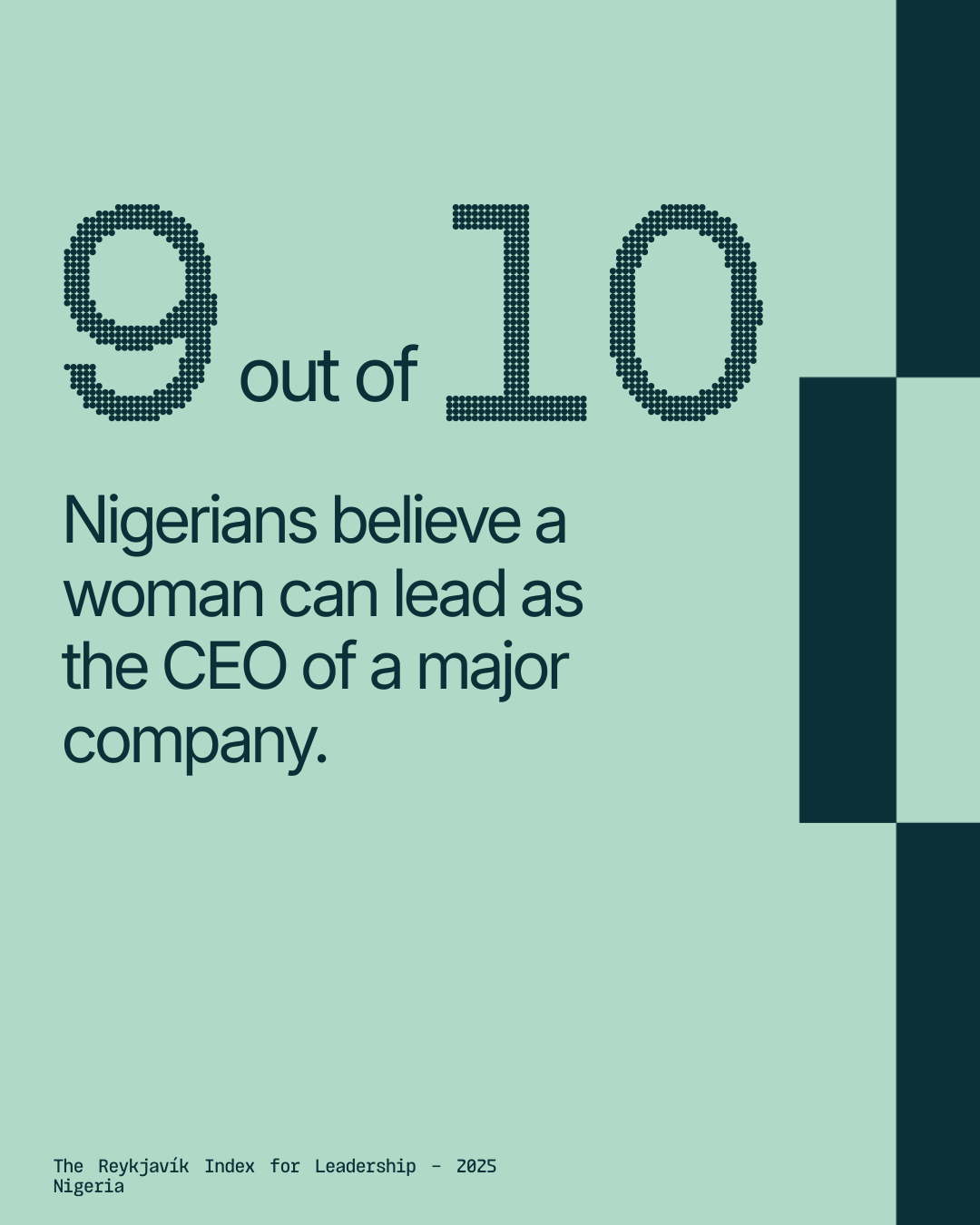
89% Want Women CEOs. Only 12% Actually Are.
Let that sink in for a second.
89% of Nigerians, men included, are comfortable with a woman leading a major company. Not 40%. Not 60%. EIGHTY-NINE PERCENT. So if almost 9 in 10 Nigerians are perfectly fine with women CEOs, why do women make up only 12% of actual chief executives?
The answer is simple, and it’s not the one you’ve been told: Boardrooms are choosing mediocre men over qualified women despite knowing Nigerians overwhelmingly support female leadership. This isn’t a pipeline problem. It’s not a skills gap. It’s not about women “leaning in” harder. It’s gatekeeping, plain and simple and the data just proved it.
The 77-point gap between acceptance and reality is institutional failure. 89% of Nigerians say women can lead companies. Only 12% of CEOs are women. That’s a 77-point chasm between what Nigerians want and what Nigerian institutions deliver. This gap isstructural exclusion and every board meeting where a less-qualified man gets promoted over a more-qualified woman widens it.
Nigerian Men Are Actually Becoming More Progressive
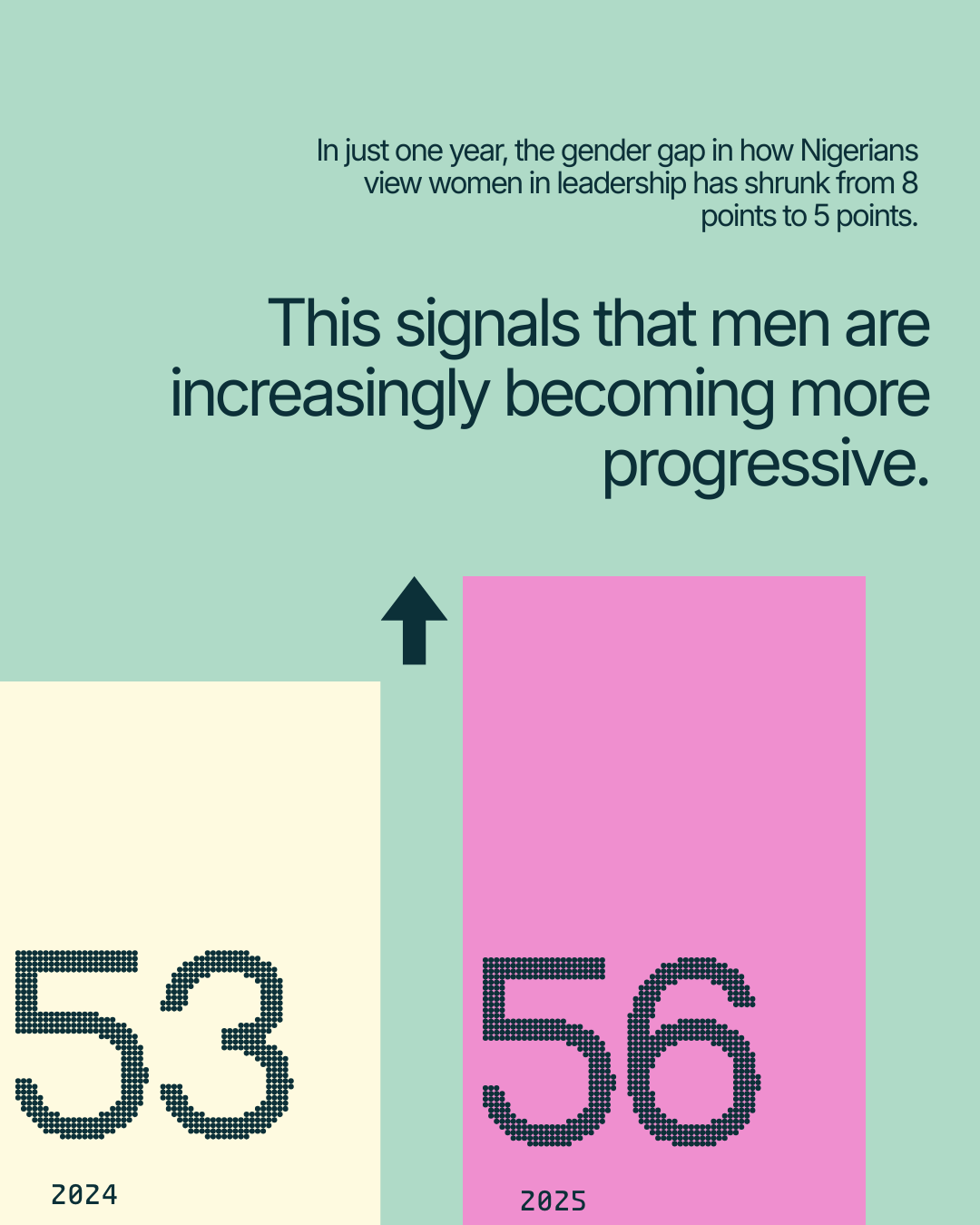
Here’s the part that will shock people who keep blaming “traditional values” for keeping women out of leadership: Nigerian men’s perception of gender equality in leadership went up by 3 points in just one year, from 53 to 56. The gender gap in how men and women view female leadership shrank from 8 points to 5.
Men, especially older men, are evolving. They’re recognizing women’s value in leadership. They’re changing their minds based on evidence and experience. So if Nigerian men, the group everyone loves to blame for resisting progress—are getting more progressive, what’s stopping our institutions from catching up? You can’t blame “culture” when the culture is literally changing in real time and institutions refuse to move. That’s not tradition, that’s power protection.
The Culture Excuse Just Died
77% of Nigerians support women in top political roles. Yet women hold only 3.9% of National Assembly seats. Let’s do that math: if three-quarters of Nigerians want women in political leadership, why do women hold fewer than one in twenty seats in parliament? The problem is not our culture. The problem is:
- Political parties refusing to field female candidates
- Electoral systems designed to keep men in power
- Party gatekeepers protecting their own access and refusing to share
- Nomination processes that prioritize “who you know” over competence
- Zero accountability for parties that consistently exclude women
Culture is ready. The system is broken. Nigeria trusts women with profit, but not with power. Women hold nearly 1 in 3 board seats (31.1%) in Nigeria’s largest companies, but fewer than 1 in 20 seats (4.2%) in parliament. Nigeria is constructing a gender order where women are trusted with markets, but not with the state. With managing money, but not with governing people. With profit extraction, but not with collective decision-making.
The long-term consequence? Women’s leadership becomes associated exclusively with corporate gain rather than public service and when political power remains male-dominated, policies that affect women’s lives, healthcare, education, economic security, continue to be designed without women’s voices in the room.
Banking Proved Nigerian Women Can Lead—And Made Money Doing It
Nigeria’s Banking and Finance sector has a Reykjavik Index score of 73, the highest in the country for gender equality in leadership. How did they do it?
- Intentional talent pipelines that identified and developed women early
- Sponsorship programs where senior leaders actively advanced women’s careers
- Accountability metrics that made gender diversity a performance measure
- Business case alignment—they made women’s advancement a strategic priority, not a charity case
And guess what happened? Banking thrived. Profitability didn’t drop. Standards didn’t fall. Innovation didn’t slow. Women led, and everyone won. If one sector can do it, all sectors can. They’re just choosing not to. Banking’s success destroys every excuse other industries make:
“We can’t find qualified women” → Banking found them
“It will hurt our bottom line” → Banking is profitable
“Our clients won’t accept it” → Banking clients adapted
“The pipeline isn’t ready” → Banking built the pipeline
“We need to move slowly” → Banking moved intentionally and saw results
Every other sectorhas the same blueprint now. Banking wrote the playbook. The only question is: which industries will have the courage to follow it, and which will keep making excuses?
“Women Should Focus on Caregiving”—That’s Why Childcare Scores 33/100
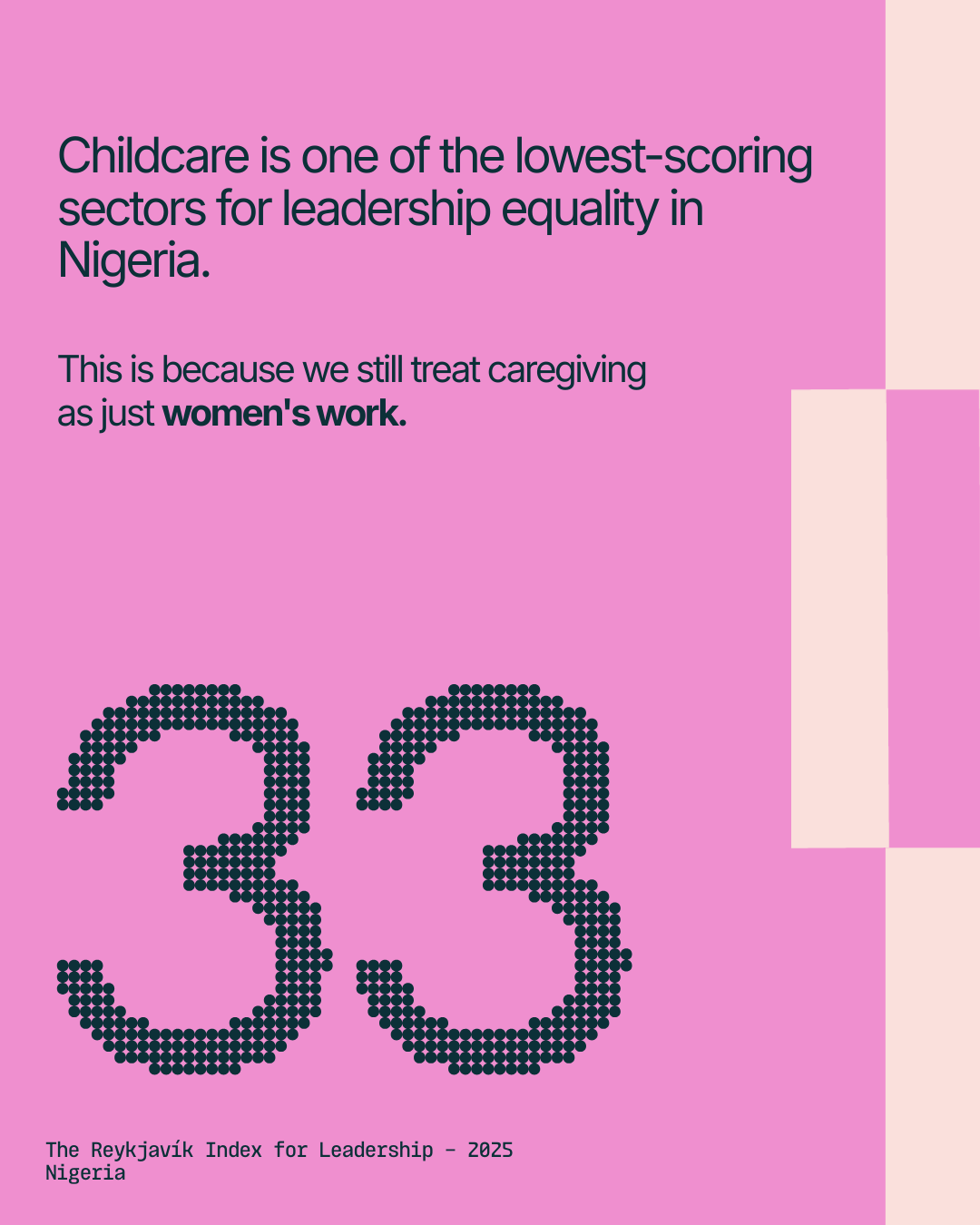
Let’s address the “women belong at home” crowd with some uncomfortable data. The childcare sector, an industry dominated by women, essential to every working parent, foundational to economic productivity, has one of the lowest Reykjavik Index scores at 33 out of 100. Childcare ranks 40 points below Banking and Finance despite being demonstrably women-led. Fashion and Beauty, despite Lagos being Africa’s fashion capital and the sector generating $6.6 billion annually, scores only 46.
Why do sectors where women already lead get devalued? Because Nigerians still see caregiving as “women’s work” instead of shared responsibility. This bias doesn’t just hurt women in childcare, it traps ALL working women.
When childcare is undervalued:
- There’s no paternity leave because “men don’t need it”
- There are no family-friendly workplace policies because “that’s women’s problem”
- Working mothers get penalized for having responsibilities men aren’t expected to manage
- Women can’t advance in other sectors because they’re carrying the full weight of care work alone
The low score for childcare isn’t about that sector, it’s about how Nigeria views women’s labor. When you treat caregiving as exclusively a woman’s problem, you ensure women can’t advance anywhere else. The message is clear: work that women do is worth less, even when it’s essential. Most interventions focus on getting women into male-dominated sectors, STEM programs, engineering scholarships, aerospace initiatives but comparable attention to elevating care sectors where women already lead at scale remains almost nonexistent. Leadership readiness requires both pathways: expanding access to new sectors and revaluing work women already perform.
Every Time Women Push for Leadership, Someone Says “Society Isn’t Ready.” The 2025 Reykjavik Index Just Killed That Excuse.
The data proves Nigerians DO support women’s leadership. Overwhelmingly. Across sectors. Across demographics. Men and women. Young and old. What doesn’t align?
- Men in power who don’t want to share access
- Executives who feel threatened by competent women
- Politicians who know female candidates would win but refuse to nominate them
- Boards that prioritize “culture fit” (read: men like us) over competence
- Systems designed decades ago to keep power concentrated in male hands
It’s power protection, and Nigerian women see right through it. Every “society isn’t ready” excuse is now documentably false. The 2025 Reykjavik Index provides receipts:
- 89% support women as CEOs
- 77% support women in politics
- Men’s progressive attitudes increased 3 points in one year
- The gender perception gap shrank by 3 points
The only people who aren’t “ready” are the gatekeepers benefiting from the current system.
Belief in Workplace Equality Dropped 7 Points—The Largest Decline in Any Indicator
In 2024, 62% of Nigerians believed gender equality had been achieved at work. By 2025, only 55% believed it. Nigeria’s index score improved, but belief in workplace equality crashed. How do you explain this? Nigeria’s overall Reykjavik Index score went UP from 57 to 59, meaning acceptance of women’s leadership increased. But belief that equality actually exists in workplaces fell by 7 points, the largest decline in any measured indicator.
Two explanations are possible, and both are damning:
1. Conditions actually worsened. The economic crisis hit women harder. Discriminatory layoffs increased. Cuts to services women depend on accelerated. Or high-profile scandals exposed patterns that were always there but newly visible.
2. Awareness grew. More women are speaking publicly about workplace barriers. Media coverage increased. Previously tolerated behavior became newly recognizable as discrimination.
Either way, the gap between acceptance and reality is widening. Nigerians increasingly believe women CAN lead—but fewer believe workplaces are actually treating women fairly. And here’s the part that should alarm everyone: Nigerian men are MORE pessimistic than women about workplace equality. 52% of men believe workplace equality exists. 58% of women believe it exists.
Nigeria reverses the global pattern. In most countries, women report lower equality because they experience discrimination directly. Men, benefiting from structural advantage, report higher equality but Nigerian men are more likely than women to say equality doesn’t exist. Why? Men’s pessimism may reflect rising visibility of inequality rather than lived exposure. They’re seeing what’s always been there. Women’s relatively higher optimism may reflect adaptation to constrained expectations rather than improved conditions.
Translation: Women have lowered their standards for what “equality” means because the bar has been on the floor for so long. Men are newly recognizing how unequal things actually are.
The Numbers Are Screaming. Are You Listening?
- 89% of Nigerians want women CEOs. Only 12% are.
- 77% support women in politics. Only 3.9% of lawmakers are women.
- Men became more progressive. Institutions stayed stuck.
- Belief in workplace equality collapsed even as leadership acceptance grew.
The numbers aren’t subtle. They’re SCREAMING that Nigerian women are being systematically blocked by gatekeepers who won’t let go. This isn’t speculation. It’s not anecdotal. It’s documented, measured, and undeniable. Nigeria doesn’t lack acceptance of women leaders. It lacks systems capable of converting that acceptance into power. The question is no longer whether Nigerians are ready for women leaders. It’s whether Nigerian institutions are fit for a society that already is.
What Should Happen Next
1. REPRESENTATION TARGETS
Demand 35% female representation across federal and all subnational executive councils, in line with existing gender policy. This must extend to the private sector: executive management teams and boards of the top 30 companies on Nigeria’s stock exchange. Not suggestions. Mandates.
2. SUPPORT THE RESERVED SEATS FOR WOMEN BILL
This legislation creates structural pathways for women in politics. It doesn’t ask nicely, it requires change. Support it loudly. Publicly. Relentlessly.
3. CORPORATE TRANSPARENCY
Require Nigeria’s top 100 companies by market capitalization to publish annual gender pay gap reports and promotion data by gender. Make the data public. Let Nigerians see which companies talk about diversity and which actually practice it.
4. CARE ECONOMY INTEGRATION
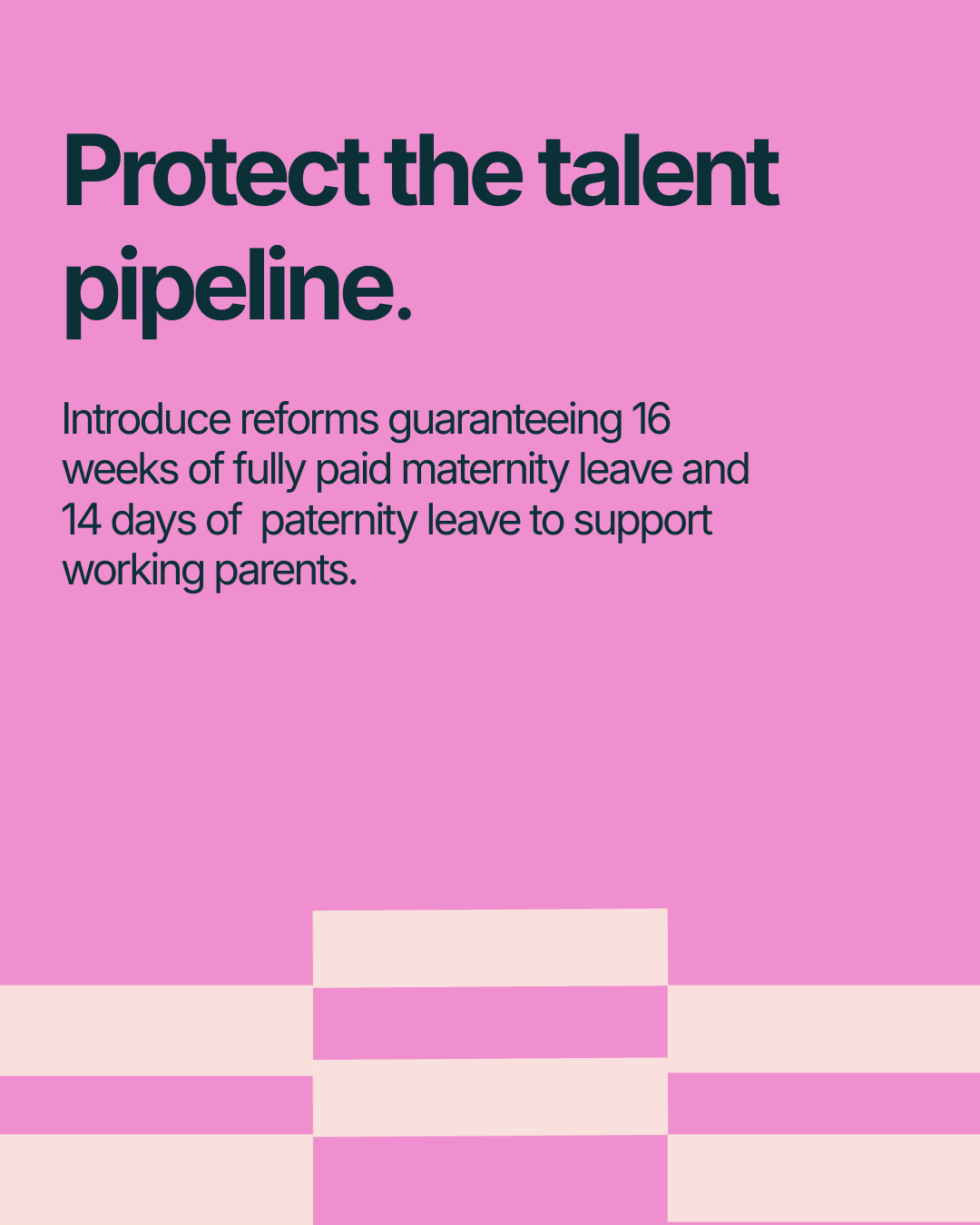
Revalue and formalize care sectors through targeted policy and capital access. Implement standardized maternity leave (16 weeks minimum) and paternity leave (2 weeks minimum). Distribute caregiving responsibility more evenly and signal that care work is not gender-specific.
When fathers get paternity leave, it stops being “women’s work.” When childcare is professionalized and compensated fairly, it stops being devalued. When working parents have support systems, mothers stop being penalized for having children.
5. SPONSOR WOMEN INTO LEADERSHIP
Give women visibility, high-stakes projects, introductions to decision-makers, advocacy in rooms they’re not in—not just advice and mentorship. Mentorship is “here’s how I navigated the system.” Sponsorship is “I’m using my power to change the system for you.” Nigerian women don’t need more advice. They need people with power to use that power on their behalf.
6. CALL OUT INSTITUTIONS THAT CLAIM TO VALUE WOMEN BUT PROMOTE ONLY MEN
The Reykjavik Index gave us proof. Now we create pressure. Tag your CEO. Tag political parties. Tag industry leaders. Tag anyone making excuses. Name the laggards. Highlight the champions. Create accountability narratives using this data.
7. MEDIA & ADVOCACY
Use this data everywhere. In op-eds, social media campaigns, shareholder meetings, policy briefs, academic papers, and dinner table conversations. The numbers are on our side. 89% of Nigerians are ready.Make the system catch up whether it wants to or not.
Banking Did It. Tech Can Do It. Your Industry Can Do It. You’re Just Choosing Not To.
Banking’s Reykjavik score of 73 proves systems can change when leaders decide to change them.
They built pipelines. Created accountability metrics. Sponsored women into senior roles. Made gender diversity a business imperative, not an HR nice-to-have.Every other sector—tech, oil and gas, manufacturing, media—has the same blueprint now. The only difference? Banking chose to act. Everyone else is still making excuses.
Which one are you?
Because 89% of Nigerians are ready for women to lead. The only question left is whether you’ll be part of the solution or part of the obstruction.