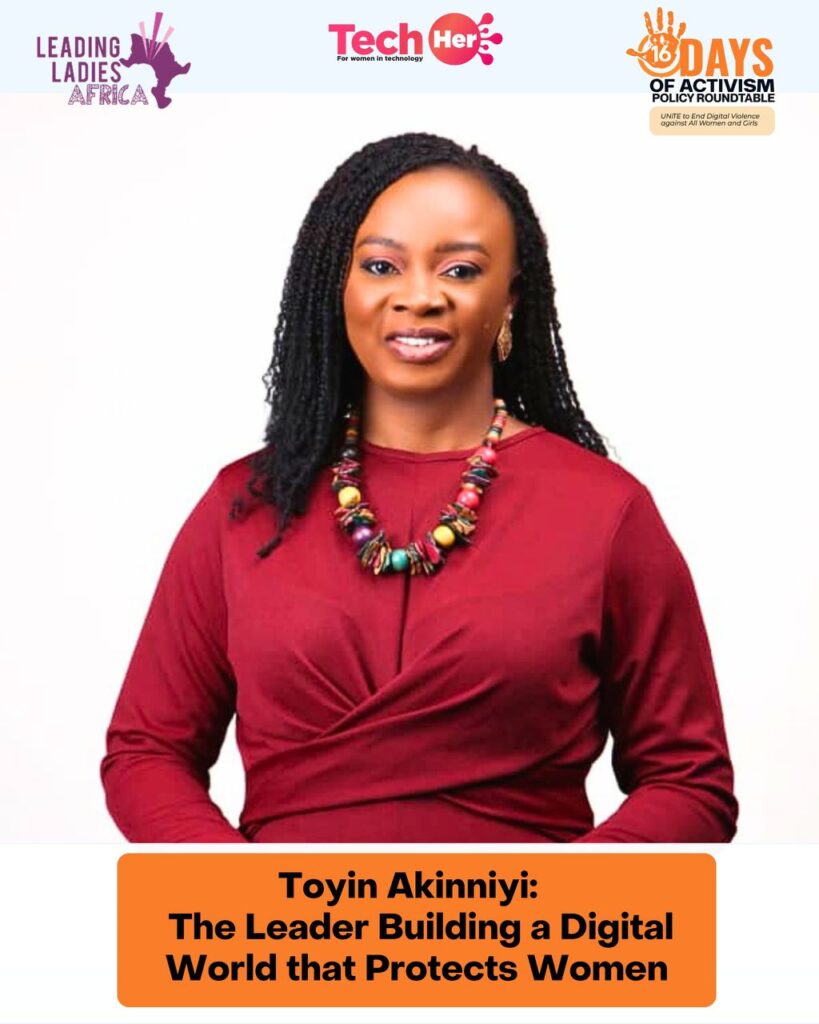
Keynote Remarks by Toyin Akinniyi
Title: Profit, Power, and Protection: Rethinking Online Safety for Women and Girls in the Digital Economy
5 December 2025

Distinguished guests, partners, advocates, and friends,It is an honour to speak on a subject that is no longer a footnote in our development conversations, but a defining frontier of human rights: the struggle for safety, dignity, and equality for women and girls in our rapidly expanding digital economy.
Digital technologies shape how we work, learn, connect, and participate in society. The digital space is a place of opportunity, the engine of entrepreneurship, the classroom of millions, the public square where ideas are shaped, and increasingly, the space where identity, belonging, and power are negotiated.
For millions of African women and girls, the digital space offers unprecedented possibilities: new livelihoods, greater voice, and expanded access to opportunity. But alongside these opportunities lie huge risks: harassment, surveillance, exploitation, disinformation, and technology-facilitated gender-based violence.
Technology has given us unimaginable power. But it has also created a new terrain of vulnerability.And that’s why this discussion, convened by TechHer and their partners, Leading Ladies Africa, is timely.
And I thank you for inviting me to share a few thoughts today, under the theme “Profit, Power, and Protection.”I’d like to start by reflecting on a question: If the digital world is now where we live, learn, work, and love, how can we ensure it’s safe, and who is responsible for making it safe?
The Reality for Women and Girls Online
Across Africa and beyond, women and girls step into digital spaces with creativity, courage, and ambition, but they sometimes do so at immense personal risk. To these women and girls, online harassment, cyberstalking, deepfakes, sexual extortion, identity theft, trafficking, misinformation, and coordinated digital attacks are not abstract threats.
They shape how women participate online, how loudly they speak – and whether they speak at all!
And the consequences spill offline. Online harms are real-world harms: mental health crises, economic losses, damaged reputations, restricted mobility, and sometimes deadly violence.
So, when we talk about digital inclusion, we need to note that access and inclusion without safety is not empowerment. Access without dignity is not development.
So, we explore the three complex things at play when we discuss these issues: Profit, Power, and Protection, within this question about safety and responsibility.
Let’s start with Profit. And we all identify with profit, but at what cost?
I want us to confront an uncomfortable truth: technology – this great engine of innovation – is not neutral.
The digital economy is built on companies whose business models thrive on attention, engagement, and scale. So, across Africa, and indeed the world, women and girls face a digital landscape shaped by:
• Profit-driven platform design that rewards engagement, even if it sometimes amplifies harmful content
• Power asymmetries in which Big Tech’s decisions affect billions of people with little or no agency.
• Weak or outdated digital policies leave survivors to navigate online harm with few remedies.
• Social norms that silence women who speak out, lead, innovate, or challenge authority.
For many women, being online comes with a tax: a tax on emotional well-being, a tax on safety, a tax on participation.
This is not simply a “women’s issue.” It is a democracy issue. It is a development issue. It is a human issue.
The digital economy cannot optimise for profit and prosperity when half the population is forced to participate from the shadows. And platforms cannot continue to claim neutrality when their design choices directly influence who is safe, who is silenced, and who is sacrificed, while making huge profit.
So, let’s now discuss Power
I love that TechHer has asked us to talk about power in this context. And so to my earlier question: If the digital world is now where we live, learn, work, and love, how can we ensure it’s safe, and, (may I emphasize this part of the question): who is responsible for making it safe?
In the digital space, technology companies wield immense power. They decide what content circulates, whose voices gain visibility, which harms are addressed, and which ones are ignored. With great power must come great responsibility but too often, platforms have abdicated that responsibility.
They have the power to detect harmful behaviour before it escalates; build safer reporting systems that women trust; train algorithms to avoid amplifying misogyny and violence; the power to invest meaningfully in moderation teams that understand African contexts, languages, and cultures, and to protect survivors instead of protecting perpetrators who create “high engagement.”
But power becomes dangerous when it is unaccountable. The reality is that women and vulnerable girls and boys are being harmed at scale, while many companies continue to act as though safety is an option rather than an ethical obligation.
Platforms must begin to understand that safety is a core component of sustainability. A digital economy that undermines the rights and dignity of women is an economy built on instability, distrust, and long-term social harm.
Protection: Reclaiming digital spaces for women and children is a shared vision
But we all have power, even if it appears dwarfed in this moment. We have the power of collective visioning, collective action to protect what is ours.
And especially if we are serious about creating a safe digital economy for women and girls, and indeed for everyone in society, we must all collectively pursue a new vision; one where safety is embedded in innovation; tech companies are held accountable for the environments they create; diverse perspectives and expertise shape national, regional and global digital policies; one where women and girls participate fully in the digital economy without fearing violence, surveillance, or erasure, and overall, one where humanity precedes profit.
Now, this future stands now. Yes, it requires policy reforms, improved legal frameworks, stronger enforcement, and sustained advocacy. But it also requires a cultural shift: one that treats online safety as a non-negotiable public good and one that empowers and protects. Protection is both a moral and a practical imperative.
A Call to Action
Today, I invite us all – platforms, policymakers, civil society, educators, and innovators -to rethink our roles in shaping the future of the digital world.
• To tech companies: Use your power to protect the vulnerable. Invest in safety. Localise your systems. Build for humans, more than profit.
• To policymakers: Build stronger, enforceable laws that reflect today’s digital threats.
• To civil society and educators: Continue supporting survivors, training young people, documenting harms, and advocating for systemic reforms.
• To every user: Demand accountability. Ask more of the technologies you depend on.
• And to women and girls everywhere: Your voice is not a liability. It is a force. You deserve to occupy digital spaces fully, boldly, and safely.
The digital economy promises transformation, innovation, and empowerment. But for women and girls, that promise will remain incomplete until we confront the interplay of profit, power, and protection head-on.
So, final question: If the digital world is where we now live, when do we start to make it safe?
The time is NOW!