Picture this: You’re 10 years old, and you hear your mother’s car pulling into the compound. The house is a mess, your younger siblings are scattered around watching TV, and you know trouble is coming. In the next five minutes, you’ve assigned tasks to your siblings and somehow transformed chaos into order before your mother walks through the door.
Fast forward to last month. Your team is stuck on a project that’s going nowhere. You see the solution clearly, a completely different approach that no one has considered. You present it, convince stakeholders, and three weeks later, you’ve not only met the deadline but exceeded expectations.
That 10-year-old organizing siblings before your mother got home? She was leading.
That professional who shifted an entire team’s strategy? She’s still leading. You’ve been doing this your whole life. You just didn’t know it had official names and frameworks.
The Leadership You Already Know
Here’s what we’ve discovered from watching the journey of thousands of African women leaders: the most powerful leaders aren’t those who learned leadership from a textbook. They’re the ones who recognized the leader they already were and became intentional about expanding their natural toolkit.
When you convinced your family to contribute money for your grandmother’s 70th birthday celebration by explaining exactly how much each person needed to give and why, that was strategic leadership in action.
When you talked your strict father into letting your younger sister go to university by presenting it as an investment in the family’s future, that was influence leadership.
When you stepped in during your church’s chaotic fundraising event and created systems that actually worked. that was architectural leadership.
The difference between leading unconsciously and leading powerfully isn’t learning entirely new skills. It’s recognizing your natural patterns and choosing when and how to apply them strategically.
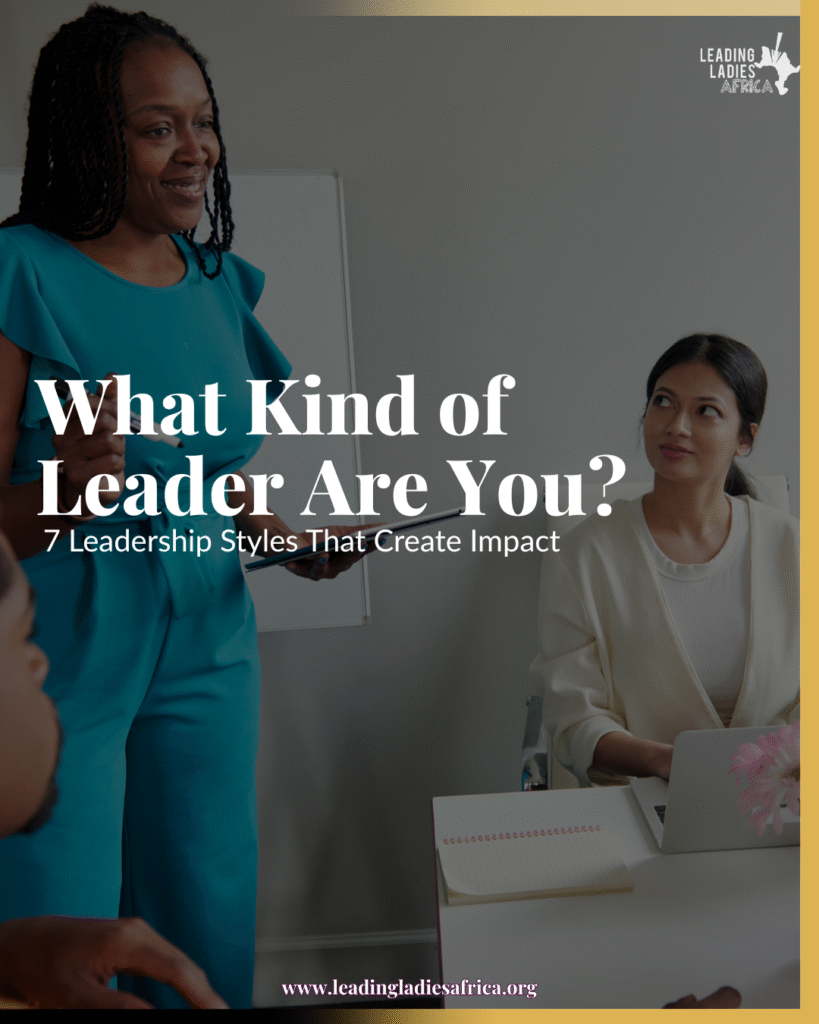
7 Leadership Styles That Create Impact
The Innovator
You’re the one who looked at your mother’s small trading business and suggested she start accepting mobile money transfers when everyone else was still dealing in cash only. When your office kept losing documents, you created a simple filing system using old biscuit tins that worked better than anything they’d tried before.
The Innovator doesn’t just think outside the box, she questions why there’s a box in the first place. You’re comfortable with being the first to try something, even if it means being the first to fail. Because you know that breakthrough innovations come from someone being willing to experiment, iterate, and push boundaries.
You see solutions in everyday items. You turn problems into opportunities. Your challenge? Sometimes you need to slow down and bring people along with your vision before jumping to the next big idea.
The Influencer
You’re the one who convinced your entire extended family to contribute to your cousin’s wedding by speaking to each aunt individually, understanding their concerns, and helping them see how their contribution would make a difference. You never demanded, you listened, understood, and then presented ideas in ways that made sense to each person.
The Influencer knows that real power doesn’t come from your position on an organizational chart. It comes from your ability to shape thinking, change minds, and move people toward better decisions. You lead through questions rather than commands, and people find themselves agreeing with you without quite knowing why.
You don’t need the loudest voice in the room because you’ve mastered the art of the strategic conversation. People seek your opinion because they know you listen first and speak with purpose.
The Strategist
You’re the one who planned your entire family’s relocation from the village to the city, mapping out jobs, schools, housing, and even which relatives to contact for support. While others worried about the immediate challenges, you were already thinking through what would need to happen in year two and year three.
The Strategist thinks in systems and sequences. You don’t just solve problems; you anticipate them. You’re the one who says, “If we do A, then B will probably happen, which means we need to prepare for C.” Your family might tease you for having backup plans for everything, but they’re grateful when those plans save the day.
You see the bigger picture while managing the details. You help families, teams, and organizations move from surviving to thriving.
The Architect
You’re the one who didn’t just organize your church’s women’s group meetings, you created a structure for rotating leadership, established a savings scheme, and set up mentoring relationships that continued working even when you stepped back. You build things that outlast your direct involvement.
The Architect looks at chaos and sees the underlying patterns that need organization. You create order not by controlling everything, but by designing systems that naturally flow toward the desired outcome.
Your legacy isn’t in any single project you’ve completed, but in the systems you’ve built that continue working long after you’ve moved on to your next challenge.
The Navigator
You’re the one who helped your family make the decision to start that small business even when you didn’t have all the capital, all the permits, or all the answers. You said, “We know enough to start, and we’ll figure out the rest as we go.” You understand that waiting for perfect conditions often means never starting at all.
Uncertainty doesn’t paralyze you, it energizes you. When your workplace was going through restructuring and everyone was frozen with worry, you helped your colleagues focus on what they could control and take productive steps forward.
You help families and organizations move through transitions, change, and crisis. You’re the steady presence that says, “We may not know everything, but we know enough to take the next right step.”
The People-First Leader
You’re the one who makes sure the junior staff members are included in important meetings, who checks on the colleague everyone else finds difficult, who remembers that your success is meaningless if your team is struggling.
You’ve figured out what many leaders take years to learn: results come through people, not despite them.
You create environments where people feel safe to contribute their best ideas. You see potential in team members before they see it in themselves. You make hard decisions about resources, but you never compromise on treating people with dignity and respect.
Your team doesn’t just produce results; they produce other leaders. Your success is measured not just in what your team accomplishes, but in where your team members go after they’ve learned from you.
The Accelerator
You’re the one who saw potential in your younger sister when she was struggling in secondary school and created opportunities for her to build confidence, maybe tutoring younger students or leading the debate team. You don’t just encourage people; you create situations where they can surprise themselves with what they’re capable of.
The Accelerator understands the difference between overwhelming people and challenging them. You give people stretch assignments that build confidence rather than breaking spirits. You see talent that’s ready to be unleashed, and you create the conditions for that to happen.
Every person you accelerate becomes someone who can accelerate others. You’re building capability that multiplies across generations.
The Power of Intentional Leadership
What makes great leaders different is that they don’t stick to one style. They read the situation, understand what’s needed, and show up accordingly.
Your team is confused about direction? You channel your inner Strategist. A project needs innovation? You tap into your Innovator mindset. Someone needs development? You become the Accelerator. The organization needs systemic change? You think like an Architect.
The most effective leaders have developed fluency in multiple styles, but they usually have one or two that feel most natural, their leadership “home base.” The key is knowing your strengths while building capability in other areas.
The question isn’t what kind of leader you should become. It’s what kind of leader you already are and how you can be more intentional about it.
Maybe you’ve always been the one who sees solutions others miss, but you’ve never thought of yourself as “strategic.” Maybe you naturally create opportunities for others to shine, but you’ve never owned the title “Accelerator.” Maybe you build systems that last, but you’ve never recognized yourself as an “Architect.”
Leadership isn’t about fitting into someone else’s framework. It’s about recognizing how you naturally move people toward shared goals and being more deliberate about when and how you do it.
The world needs the leader you already are. It needs your unique combination of vision and pragmatism, innovation and execution, strategy and heart. It needs leaders who understand that real change happens when you combine natural talent with intentional development.
So the next time someone asks about your leadership experience, don’t start with your job title. Start with the 10-year-old who organized those chores before your mother got home. Start with the person who’s been solving problems, moving people, and creating change long before anyone called it “leadership.”
Because you’ve been leading all your life. You just didn’t know it had a name.
What leadership style do you recognize most in yourself? How will you lead more intentionally moving forward?